
Specialist certification, in person in Edmonton
Single Braids Specialist: Knotless and Regular
This certification teaches two services. Not one, and not one as practice for the other. Two full technical modules, two capstone installs assessed to the same standard, and two price menus you write yourself.
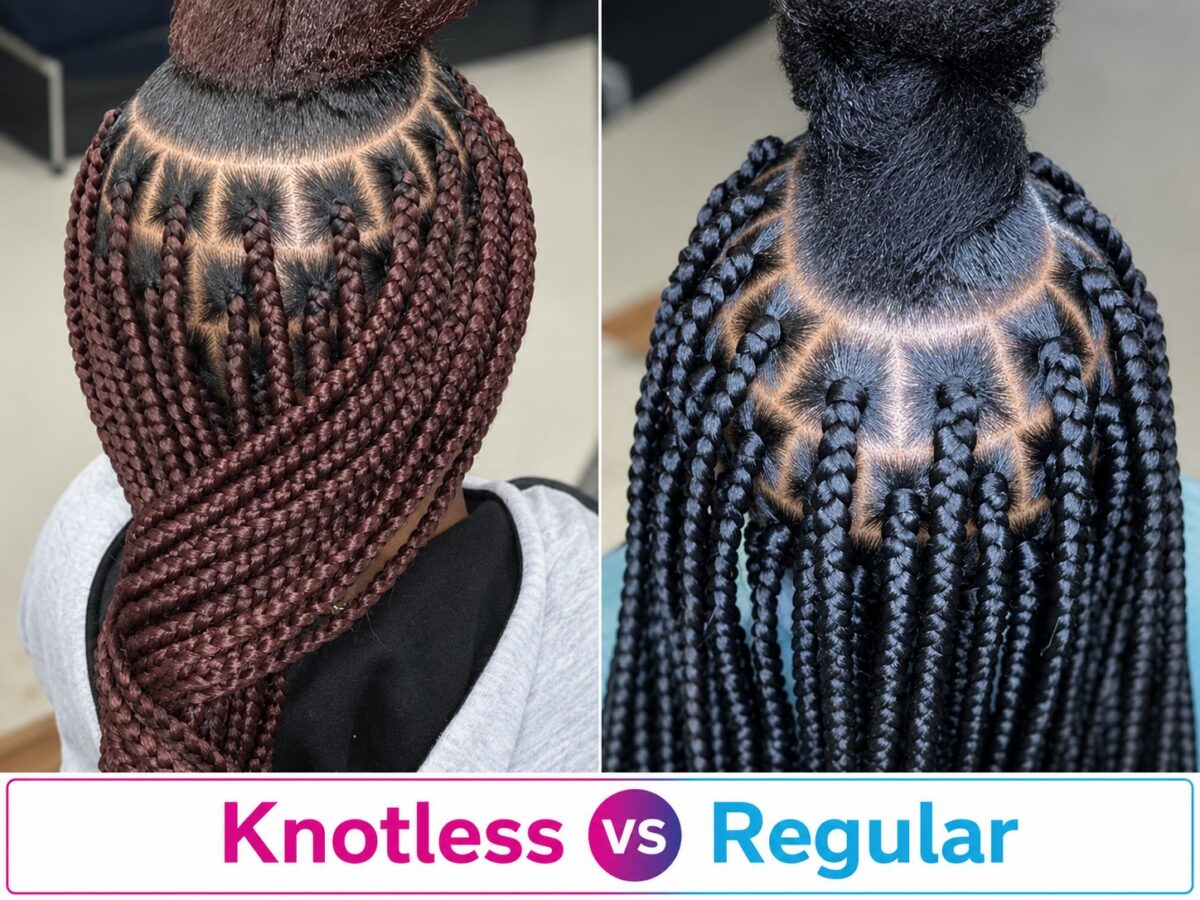
Two services, priced and assessed separately
Regular box braids are faster to install, more affordable for the client, and specifically requested by people who want the classic hold. Knotless is gentler on the hairline, starts more naturally, and commands a premium. They are different services, with different install times, different price points and different clients. Most training treats one of them as a warm-up.
Nothing on this page describes regular box braids as a stepping stone. They get their own module, their own half of the capstone and their own price menu.
How the two services differ
| Detail | Regular, knotted | Knotless |
|---|---|---|
| How the extension starts | Anchored with a knot at the base | Fed in gradually so the braid starts with the client’s own hair |
| Typical install speed | Faster | Slower, which is why it carries a premium |
| Hairline load | Heavier at the start point, safe when tension is correct | Lighter at the start point, still damaging if installed too tight |
| Client who asks for it | Wants the classic hold and a more accessible price | Wants the natural start and the gentler feel |
| Where it is taught here | Module 3, six lessons, its own pricing lesson | Module 4, seven lessons, the heaviest module in the track |
| In the capstone | A timed half-head | A timed half-head |
Regular, knotted
- How the extension starts
- Anchored with a knot at the base
- Typical install speed
- Faster
- Hairline load
- Heavier at the start point, safe when tension is correct
- Client who asks for it
- Wants the classic hold and a more accessible price
- Where it is taught here
- Module 3, six lessons, its own pricing lesson
- In the capstone
- A timed half-head
Knotless
- How the extension starts
- Fed in gradually so the braid starts with the client’s own hair
- Typical install speed
- Slower, which is why it carries a premium
- Hairline load
- Lighter at the start point, still damaging if installed too tight
- Client who asks for it
- Wants the natural start and the gentler feel
- Where it is taught here
- Module 4, seven lessons, the heaviest module in the track
- In the capstone
- A timed half-head
Tuition, for both services
$1,997CAD
- Early-bird $1,497 first 5 registrations, code KNOTLESS at checkout
- Pay in full, or split it into 4 interest-free instalments with Afterpay at the Square checkout
- $37 per supervised contact hour
That per-hour figure covers two complete services, not one.
Why students choose Celegant
- Two co-equal technical modules, one per service
- Transitions assessed on scalp-level photographs
- Timed install drills from the first week
- A professional skills certificate, not a provincial licence
Course facts
- Level
- Specialist. Open to experienced braiders and to Foundations graduates
- Format
- In person, Edmonton
- Language of instruction
- English
- Duration
- 9 weeks, 6 modules, 31 lessons
- Schedule
- Thursdays and Fridays, 10:00am to 1:00pm
- Class size
- Maximum 8 students, 2 instructors
- Location
- Unit 316, 8925 51 Ave NW, Edmonton, AB T6E 5J3
- Contact hours
- 54 supervised hours
- Kit
- Mannequin head with human hair, tripod stand, hair clips, rat tail comb and braiding hair, included at no extra cost
- Certificate
- Professional Specialist Certificate in Single Braids (Knotless & Regular)
- Tuition
- $1,997 CAD
- Next intake
- 1 March 2027
Services taught: regular knotted box braids and knotless box braids, as two full offerings. You practise on a mannequin. We do not use live models. Assessment is a six-part capstone in the final week, covering both services.
To complete the certification you need at least 80% attendance and at least 70% on your assessments, which are assignment based. There is no deposit. You can pay in full, or split the cost into 4 interest-free instalments with Afterpay at the Square checkout, at no extra cost to you.
What you will be able to do at the end
Sit a client down and ask what they actually want, then deliver either service to a standard that photographs, at a pace that pays.
- Execute a specialist-grade knotted start: secure enough to hold for weeks, light enough to protect the hairline, fast enough to be worth your hourly rate
- Execute a knotless start with an invisible transition, checked on a scalp-level close-up rather than from across the room
- Install full heads at every size from micro through jumbo, and know the time and price implications of each
- Part a full head four ways: square, triangle, brick-lay, where the rows are offset like bricks in a wall, and crescent, where the parts curve with the shape of the head. Match the pattern to the client’s hairline and preference
- Build long knotless braids that stay even from root to tip, with no mid-braid bulge and no thin ends
- Install boho knotless with curly pieces placed deliberately rather than scattered, plus curly-end and goddess variations
- Blend colour: ombre fades, peekaboo highlights and money-piece framing, without a harsh line
- Diagnose and fix the six faults that stop most braiders, visible knot, lumpy transition, slipping braid, thin ends, uneven sizing and frizz, calmly and mid-service
- Run the regular versus knotless consultation without steering the client toward whichever one you prefer doing
- Leave with a verifiable Professional Specialist Certificate in Single Braids (Knotless & Regular) and a portfolio covering both services
Who this certification is for
Your knotless transitions still show. You can do the technique. There is a small bump or a slight thickening at the start, and it is the reason you do not post scalp-level photos.
You are too slow to make knotless pay. A beautiful head that takes nine hours loses you money. Module 4 has a full lesson on where the seconds actually go, and you will time yourself before and after.
Your sizing drifts. Braid twelve looks like braid twelve. Braid ninety looks like a different service. There is a gauge method for this and it is taught in module 2.
You undercharge regular box braids. You price them as the cheap option because that is how you were taught to think about them. This certification gives regular box braids their own module, their own capstone half and their own price menu.
Your long knotless goes lumpy or stringy. Length is a system, not “keep going”. One full lesson in module 4 is entirely about feed schedule across a waist-length braid.
You want to say yes to boho. Boho knotless is everywhere and most of it is done badly, with curls bunched at the ends and placed at random. Placement is a strategy and it is taught as one.
New to this? If you cannot yet braid a clean single braid with even strand thickness, we would point you at the Celegant Foundations In-Person Braiding Intensive first. It is our recommended starting point for beginners, not a gate. There is no entry requirement for this certification. If you already braid to a professional standard, you can apply straight to it, and if you are not sure which is right for you, come and talk to us.
Skills and services this certification covers
Regular, knotted, box braids
- Specialist-grade knotted start, hairline-safe
- Full-head installs, small through medium
- Jumbo and large box braids as a distinct, faster-priced service
- Square, triangle, brick-lay and crescent parting applied to real installs
- Sealing, styling and finishing: half-up, bun and ponytail
- Standalone pricing and consultation
Knotless box braids
- Knotless start with an invisible transition
- Micro, small, medium, large and jumbo sizing
- Long-length systems with smooth continuous feed
- Three-zone tension control across the hairline, crown and nape
- Speed drills and realistic benchmarks by size
- Six-fault diagnosis and live correction
Premium variations across both
- Boho knotless with placed curly pieces, water wave and French curl
- Curly-end and goddess variations
- Ombre, peekaboo and money-piece colour blending
- Beads, cuffs and accessories, priced as add-ons
- Updos, buns and photo-ready styling
- Refresh, safe takedown and aftercare
The curriculum, module by module
Six modules across nine weeks. Modules 3 and 4 are the two technical cores, one for each service.
Welcome and Specialist Orientation
Week 1, first session. Why this track treats regular and knotless as two professional services, plus station and inventory setup.
- What you learn. What the credential certifies and what it does not. Why this track treats regular and knotless as two professional services rather than one path. Station setup for efficiency, with hair pre-separated and within reach, tools placed for your dominant hand and the mannequin at working height, and the hair inventory this track needs, from micro to jumbo, regular and pre-stretched.
- Why it matters. Specialist speed is part skill and part setup. A station that fights you costs seconds on every braid, and seconds multiply into hours across a full head.
- What you practise. A baseline video of three current single braids, filed with your instructor for the final-week comparison. The entry-standard checklist run against your own work, live. A full station build and one pack of hair pre-separated into feed-in sizes.
- The professional outcome. You know your weakest habit and you have fixed your setup before it costs you a cohort’s worth of minutes.
Single Braid Foundations and Parting Systems
Weeks 1 and 2. The single braid as a unit, the four parting systems, sizing and hair quantity, and the honest consultation.
- What you learn. The single braid as a unit: one isolated section braided its full length, why even strand thickness controls the whole look, and how to braid to the ends without thinning or fishtailing. Then the four parting systems. Square, the standard, and how to keep it uniform on a curved head. Triangle, which shows less scalp, distributes tension and reads as premium. Brick-lay, with offset rows so scalp does not show in straight lines. Crescent, curved sections that follow the head for a face-framing finish. Then sizing: the five braid-size categories and what each does to install time, comfort, longevity and price, estimating braid count and packs of hair before you start, and the gauge trick that keeps size consistent across a full head. Then the decision framework, reading hair type, hairline sensitivity and budget to recommend regular or knotless honestly.
- Why it matters. Clients do not consciously notice good parts. They always notice bad ones. And running out of hair mid-service, or sizing so inconsistently the head reads lumpy, are the two mistakes that follow braiders into paid work.
- What you practise. Six single braids judged on even strand thickness end to end. A full mannequin head parted in all four systems across four quarters. A written hair-and-time plan for a medium-size full head, sanity-checked by your instructor. A client-facing explanation of the regular versus knotless choice you could actually use in a consultation.
- The professional outcome. A full head parted two ways with ten to twelve consistent single braids, signed off before you advance. You can now plan a service instead of improvising one.
Regular Box Braids, a full service in its own right
Weeks 3 and 4. The knotted start at specialist grade, installs at every size including jumbo, and a dedicated pricing lesson.
- What you learn. The knotted start at specialist grade: anchoring extension hair securely, tension that holds for weeks without stressing the hairline, and consistent strand thickness root to tip. Full-head sequencing at small and medium sizes, the bread-and-butter booking. Jumbo and large, and how grip, tension and pace change at scale, and how to price a faster service without devaluing it. Then applying box, triangle and crescent parting to real installs, so a client can request a look by name and you can deliver it. Then sealing, styling and the after-photo. Then a dedicated lesson on positioning and pricing regular box braids confidently, by size, length and parting style, without apologising for them.
- Why it matters. Regular box braids are their own market. Many clients specifically want the classic hold and the more accessible price. Treating that service as a lesser version of knotless leaves money and clients on the table.
- What you practise. Ten timed knotted starts. A half-head at small or medium size. A quarter-head of jumbo or large, timed against your medium pace. A section in triangle or crescent parting. A finished section styled two ways and photographed. A regular box braid price menu by size and parting style.
- The professional outcome. A full or three-quarter-head regular install, timed, with a price quote attached, assessed to the same standard as any paid appointment.
Advanced Knotless Box Braids
Weeks 5 to 7, the heaviest module in the track. The invisible start, tension zones, sizing, length as a system, speed and the six faults.
- What you learn. The knotless start made invisible: how much natural hair to anchor before the first feed, the placement and angle that hides it, feeding small and often, and matching feed amount to the client’s density so the braid neither bulges nor thins. Then tension across the three zones, and how to adjust for fine, fragile or relaxed hairlines. Then sizing. Micro and small, meaning precision, feed control and the time premium. Medium, the everyday request. Large and jumbo, with a bigger first feed but without a bulky start. Then length as a system: planning the feed schedule for a waist-length braid so it stays even root to tip, and knowing where to stop feeding and braid the extension out. Then speed, built by eliminating wasted movement rather than rushing the stitch. Then the six faults, visible knot, lumpy transition, slipping braid, thin ends, uneven sizing and frizz, each recreated deliberately by the instructor and corrected live. Then full-head sequencing.
- Why it matters. This is the technical core of the knotless half and where most of the practice volume lives. Knotless commands premium pricing precisely because it takes longer and asks more of the braider. If you cannot do it at a viable pace, the premium disappears into your own unpaid hours.
- What you practise. Ten knotless starts, judged on transition invisibility rather than speed. A light-tension hairline row beside a secure-tension nape row. Five-braid patches at small, medium and jumbo, each timed. Three braids at mid-back length or longer. Ten medium braids timed, efficiency drills applied, then ten more timed. Two faults deliberately created and corrected in front of the instructor.
- The professional outcome. A half-head of medium knotless, roughly thirty to forty braids, with a parting grid, three scalp-shot transitions, a full-length braid shot and a total timed install. This is the central technical proof of the knotless half of the certification.
Boho, Curly and Styled Variations
Weeks 7 and 8. Boho placement strategy, curly-end and goddess work, colour blending, accessories, styling and the full lifecycle.
- What you learn. Boho knotless done properly: choosing curly hair, water wave or French curl, matching texture, then placement strategy, where curls go, how much to leave out, and the natural-distribution principle that stops it looking like an accident. The two classic mistakes are named and shown: too many curls, and curls placed too high or too low. Then curly-end and goddess variations, where to stop braiding for the cleanest curl release, and how to define curls after install. Then colour: blending two or more tones, ombre placement that reads naturally, peekaboo and money-piece framing, and the blending-feed technique that avoids a harsh line. Then beads and cuffs, secured without damaging the braid and balanced so they do not drag on the scalp. Then styling, half-up, bun and ponytail looks that work on both services. Then the full lifecycle: aftercare by service, hairline refreshes between installs, and a safe takedown that protects the natural hair.
- Why it matters. Standard installs are the bread and butter. Variations are the premium menu, and they are what gets you tagged.
- What you practise. Five boho knotless braids with deliberate curl placement. Four curly-end braids with defined curls. A section with an ombre or colour blend, plus your reasoning. Beads and at least one cuff. A completed section styled three ways with a polished after-photo of each. A safe takedown and a hairline refresh.
- The professional outcome. A styled boho or curly-end section with at least one premium element, finished and presented. Proof you can deliver the work clients screenshot.
Certification Capstone and Becoming a Specialist
Week 9. A combined price menu, the time-to-rate calculation for each service, a dual-service portfolio and the capstone.
- What you learn. Building a combined price menu covering both services by size and length, with premium variations priced as add-ons to either. The time-to-rate calculation for each, because knotless and regular have very different hour profiles. Local positioning, and how to raise prices as your speed and portfolio grow. Then a portfolio that shows range across both services without diluting your brand, using the shots that actually sell: scalp transition, full length, finished style, and before and after.
- Why it matters. The most common mistake at this stage is pricing like a beginner, or pricing regular braids as an afterthought.
- What you practise. A finalised combined price menu, shared with the cohort. A portfolio spanning both services. Coached practice on your weakest area before assessment.
- The professional outcome. You leave with a menu, a portfolio, a credential and a one-to-one debrief.
What you will actually be doing in the room
Sessions run as an instructor demo, first slowly with narration and then at real time, followed by supervised practice with hands-on correction. Over the nine weeks you will complete, among others:
- Six single braids assessed on even strand thickness
- A full head parted in all four systems, one per quarter
- A written hair-quantity and install-time plan for a medium full head
- Ten timed knotted starts
- A half-head of small or medium regular box braids
- A quarter-head of jumbo, timed against your medium pace
- A regular install section in triangle or crescent parting
- Ten knotless starts assessed on transition invisibility
- Five-braid patches at small, medium and jumbo, each timed
- Three braids at mid-back length or longer
- Two timed sets of ten medium knotless, before and after speed drills
- Two faults created and corrected live
- Five boho knotless braids with deliberate curl placement
- Four curly-end braids
- A colour-blend or ombre section
- A finished section styled three ways and photographed
- A safe takedown and a hairline refresh
Both service tracks, lesson by lesson
The download sets out all six modules, both capstone halves, the tools list and the assessment standard. No payment on a first visit.
Assessments and what you leave with
Module skills submissions. Module 2 must be signed off before you advance. Module 3, a full or three-quarter-head regular install, timed, with a price quote, and module 4, a half-head of medium knotless with three scalp transitions, are the two major technical capstones, one per service.
The final capstone, assessed in person, in six parts
- Regular box braids. A half-head using one of the four parting systems, at your choice of size, with a secure hairline-safe knot and a clean finish. Timed.
- Knotless. A half-head with an invisible transition, consistent sizing and a clean finish. Timed.
- Premium element. At least one variation, boho or curly, colour, or accessories, worked into either half.
- Documentation. Parting grids, transition and knot close-ups, finished styles from multiple angles, and both timed installs.
- Service package. A combined price menu, a mock consultation showing the regular versus knotless conversation, and a personalised aftercare sheet.
- Reflection. Your biggest improvement since the module 1 baseline, and the variation you most want to master next.
On passing you receive the verifiable Professional Specialist Certificate in Single Braids (Knotless & Regular), a dual-service portfolio built from your own work, a combined price menu covering both services, all sizes and your add-ons, and a consultation script and aftercare sheet.
Coming back for a second specialty. 20% off your next specialty certification when you enrol within 90 days of completing one. That is a standing offer, not a launch promotion.
The four proofs of a single braids specialist
Signature techniques you will own
The invisible knotless transition
Anchor depth, first-feed angle, and small-and-often feeding matched to density. Assessed on a scalp-level photograph.
The hairline-safe knotted start
Secure enough to hold for weeks, light enough that the client’s edges are the same in six weeks as they are today.
Length control
A waist-length braid with no mid-braid bulge and no stringy end, because the feed schedule was planned before you started.
Deliberate boho placement
Curl pieces distributed to look effortless, which takes more thought than scattering them does.
Tools and materials
- Braiding hair in multiple sizes, micro through jumbo, in both regular and pre-stretched
- Curly and water-wave hair for boho and curly-end work, including French curl
- Pre-coloured hair packs for ombre and peekaboo blending
- Rat-tail comb and sectioning clips
- Edge tool
- Hot-water setup for sealing
- Beads and cuffs
- A timer, used from the first week
- A mannequin at working height
- A camera or phone for transition close-ups and portfolio
Your kit comes with the course. Mannequin head with human hair, tripod stand, hair clips, rat tail comb and braiding hair, included at no extra cost. It is yours to keep. If you already own some of it, bring what you have and we will supply the rest.
Tuition and payment
Full certification, both services
$1,997CAD
- Early-bird $1,497 first 5 registrations, code KNOTLESS at checkout
- Pay in full, or split it into 4 interest-free instalments with Afterpay at the Square checkout
- $37 per supervised contact hour
All prices include GST. The figure above is what you pay.
No deposit, and no interest. Pay in full, or split the cost into 4 interest-free instalments with Afterpay at the Square checkout, at no extra cost to you. Afterpay is offered through Square. You choose it at the payment step inside the secure Square checkout, not on a separate page.
Funding. See tuition, instalments and funding options.
How enrolment works. Download the curriculum first: every module, every lesson, both capstone halves and the tools list. If it is right, you can reserve your seat from there. No first-visit checkout.
Schedule and location
In person only. Transition invisibility and tension safety are the two things a student genuinely cannot assess in their own work. Both need someone checking by hand.
The specialty certifications run two afternoons a week: Thursdays and Fridays, 10:00am to 1:00pm. The next intake is 1 March 2027. Contact hours, class size and the address are all in the course facts above and in the footer of every page.
Finding us. Unit 316 is in building 3. It is not on a third floor. The site is single storey, so there are no stairs and no lift between the car park and the classroom. Parking is ample and includes two designated accessible spaces, and the salon and store are wheelchair accessible.
The washroom is not a wheelchair-accessible washroom. A wheelchair fits inside it, but there is not enough clearance to turn around and there are no grab bars. We would rather tell you that now than have you find out on the day.
Who teaches this

Dr. Tina
Lead Instructor
Dr. Tina is a Master Braider and the Lead Instructor of Celegant Braiding Academy. She has braided more than 3,500 clients since 2016, has run her own salon since 2015, and teaches every Academy program personally, with a co-instructor alongside her.
- Master Braider
- Braiding clients since 2016, and running her own salon since 2015
- Experienced braider and loctician
- Experienced wig maker, and wig and weave installer
- A working braider at Celegant Hair Edmonton, not only an owner
Why that matters for this particular certification. Protective braids are core services at Celegant Hair Edmonton, the professional braiding salon at the same address. The tension standards, sizing consistency and install pacing taught in this room are the standards paying clients are served to, and Dr. Tina has written publicly about installing protective styles for a living.
Dr. Tina teaches from experience rather than from theory, with a real example behind every point, and she adapts her pace and her explanations to how each student in the room actually learns. Her approach in her own words is on the About page.
Questions braiders actually ask
What is the actual structural difference between knotless and regular?
One thing: how the extension hair is introduced. Regular anchors it with a knot at the base. Knotless feeds it in gradually as you braid down, so the braid starts with the client’s own hair. Everything else, the comfort difference, the price difference, the install-time difference and the way each sits at the hairline, follows from that single change. Module 2 covers it with both started side by side on matched partings, so you can see it rather than take our word for it.
Is knotless actually better for the hairline, or is that marketing?
It starts lighter at the scalp, which generally means less pull at the point where hair is most vulnerable. But a knotless braid installed too tightly will still damage edges, and a knotted start done with correct tension will not. The technique matters more than the category, which is why tension gets its own full lesson rather than a bullet point.
This guidance is educational and is not medical advice.
Why does this course spend a whole module on regular box braids?
Because regular box braids are a real service that clients specifically book. Faster to install, more affordable, and a classic look. Treating them as a warm-up for knotless means you never learn to price or pitch them properly. Module 3 gives them a specialist-level start, full-head installs at every size including jumbo, all the parting systems, styling, and their own pricing lesson. The final capstone assesses both halves to the same standard.
How long should a full head of knotless actually take me?
That depends on size and length. The honest answer is the one you measure for yourself. What the course does is give you realistic benchmarks by size, time you against your own baseline, and show you where the seconds actually go: hand path, hair reach, tool placement and pre-fluffing. You will time ten braids, apply the drills, and time ten more. The improvement is yours to see.
My knotless braids get lumpy halfway down. What is wrong?
Almost always feed timing: feeding too much too rarely, so the braid grows in steps instead of smoothly, or continuing to feed past the point where you should braid the extension out. Module 4 treats length as a planned system, then recreates the fault deliberately so you can see the cause before you learn the fix.
Do you teach boho and goddess braids, or just standard?
Module 5, six lessons. Boho with placed curly pieces, curly-end and goddess variations, colour blending, and accessories. The emphasis is on placement strategy, because most boho work fails on distribution rather than technique.
Do I need to take Foundations first?
No. There is no entry requirement for this certification. Anyone with enough experience can apply directly. Foundations is our recommended starting point for beginners, not a gate. What this program does assume is that you can already braid a clean single braid with even strand thickness. If you cannot yet, start at Foundations.
Is this a licence to braid hair professionally in Alberta?
No. Celegant issues a professional skills certificate, not a provincial trade certificate, licence or government credential. Read the honest answer on Alberta’s rules.
What if I miss a session?
See refunds and rescheduling for the current policy.
Where this leads next
Twists are the natural companion: the gentlest protective family, and something to offer clients whose hairlines need a break from braids. Locs is the route to the deepest, most repeat-driven client relationship in the craft. Cornrows and feed-ins adds parting artistry, and together with this certification it covers most of what walks into a braiding salon.
Specialty certification
Twists Specialist
Full-head protective twists and flat twists with seamless extensions, plus passion, Senegalese, kinky and spring twists.
- 8 weeks
- 48 contact hours
- In person, Edmonton
$1,997
Early-bird $1,497, first 5 registrations, code TWISTS at checkout
Specialty certification
Locs Specialist
The deepest track we teach: loc creation, maintenance, repair, extensions and the long-term care a years-long client relationship needs.
- 10 weeks
- 60 contact hours
- In person, Edmonton
$1,997
Early-bird $1,497, first 5 registrations, code LOCS at checkout
Specialty certification
Cornrows & Feed-Ins Specialist
Advanced parting and grid artistry, seamless feed-ins, and the stitch, lemonade and tribal styles clients ask for by name.
- 8 weeks
- 48 contact hours
- In person, Edmonton
$1,997
Early-bird $1,497, first 5 registrations, code CORNROWS at checkout
What this credential is, and what it is not
Celegant Braiding Academy issues a professional skills certificate. It is awarded by us, based on assessed practical work. It is not a provincial trade certificate, not a government licence, and not an apprenticeship credential.
In Alberta, Hairstylist is a compulsory-certification designated trade. Braiding is not named specifically in the government sources we reviewed, and we will not guess on your behalf. The authoritative answers live with the province:
- Restricted Activities List, Hairstylist, Alberta Apprenticeship and Industry Training: tradesecrets.alberta.ca
- Barber and Hairstylist certification in Alberta: alis.alberta.ca
- Apprenticeship and Industry Training Client Service Offices: call them and ask about your exact situation.
If your plan is to cut and chemically treat hair as a licensed hairstylist, the apprenticeship route is the one you want, and we will tell you that plainly. Our program is for braiding, twisting, locing, crochet and install work, and for the business skills that go with them.
Educational information only. This is not legal advice.
Scalp and hair safety. Tension, traction and scalp-health guidance in this program is educational and is taught for the safe practice of protective styling. It is not medical advice. Refer clients with hair loss, scalp conditions or suspected reactions to a physician or another qualified professional.
Ready?
Download the full curriculum: every module, every lesson, both service tracks, the tools list, and the six-part capstone standard.