
Specialist certification, in person in Edmonton
Cornrows & Feed-Ins Specialist
Every cornrow design is a parting problem first. This is the certification that teaches you to map a head before you braid it: curved, diamond, circular, zigzag and layered grids, a feed-in blend nobody can find, where extension hair is added a little at a time so no step ever shows, and the stitch, tribal and custom designs that get screenshotted and brought to you.
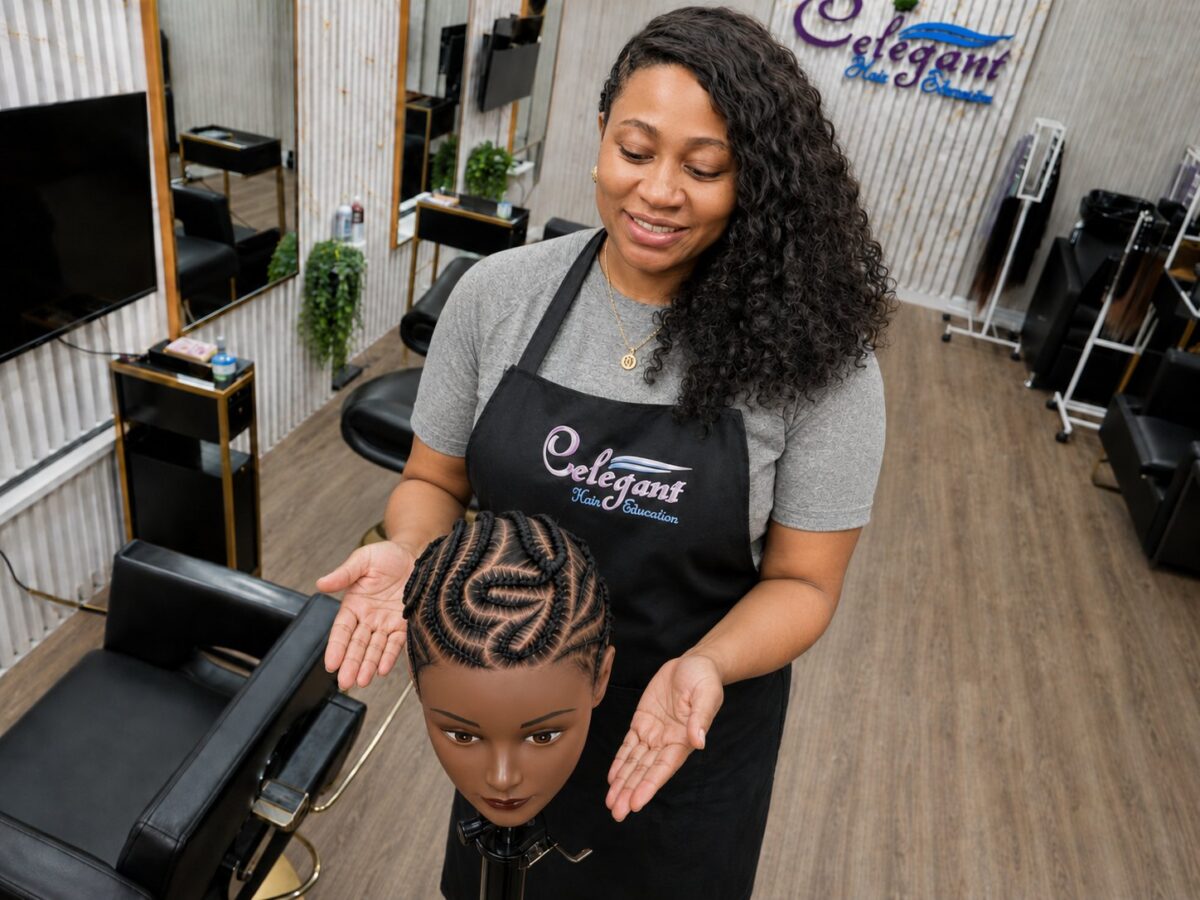
Why students choose Celegant
- Advanced parting geometry, taught as a discipline of its own
- Feed-in blends assessed at scalp level, not from across the room
- Coached by hand, in the room, on a real head form
- A professional skills certificate, not a provincial licence
Before a single braid goes in, the whole style has already been decided: by where the lines fall, whether the curve holds its width, and whether the grid resolves cleanly at the nape. Clients do not know that is what they are looking at. They just know when it looks right.
Tuition, published openly
$1,997CAD
- Early-bird $1,497 first 5 registrations, code CORNROWS at checkout
- Pay in full, or split it into 4 interest-free instalments with Afterpay at the Square checkout
- $42 per supervised contact hour
What you will be able to do at the end
By the final week you should be able to take a reference photo off a client’s phone, work out the parting plan inside it, adapt that plan to the actual head in front of you, a different hairline, a different density, a different shape, and execute it with a feed-in blend that cannot be located with a close-up photo.
That is the whole outcome, and it is a specific one. It is not “learn cornrows”. You already know cornrows.
Concretely, on passing you will:
- Map and execute curved, diamond, circular, spiral, zigzag and combination parting grids on a full head
- Feed in so gradually that the natural-to-extension transition is invisible in a scalp-level photograph
- Install feed-in straight-backs, feed-in ponytails and side-swept lemonade braids at a working pace
- Braid stitch braids with ridges that are even and defined along the entire length, not faint, not drifting
- Build tribal and Fulani-inspired layouts with correct proportion, and talk about where those styles come from with accuracy
- Price cornrow work in tiers instead of one flat rate, and hold that pricing
- Leave with a verifiable Professional Specialist Certificate in Cornrows and Feed-In Braids and a six-image design portfolio
Course facts
- Level
- Specialist. Open to experienced braiders and to Foundations graduates
- Format
- In person, Edmonton
- Language of instruction
- English
- Duration
- 8 weeks, 5 modules, 25 lessons
- Schedule
- Tuesdays and Wednesdays, 10:00am to 1:00pm
- Class size
- Maximum 8 students, 2 instructors
- Location
- Unit 316, 8925 51 Ave NW, Edmonton, AB T6E 5J3
- Contact hours
- 48 supervised hours
- Kit
- Mannequin head with human hair, tripod stand, hair clips, rat tail comb and braiding hair, included at no extra cost
- Certificate
- Professional Specialist Certificate in Cornrows and Feed-In Braids
- Tuition
- $1,997 CAD
- Next intake
- 1 March 2027
You practise on a mannequin. We do not use live models. Assessment is a five-part capstone taken in person in the final week. Format is hands-on and coached in the room.
To complete the certification you need at least 80% attendance and at least 70% on your assessments, which are assignment based. There is no deposit. You can pay in full, or split the cost into 4 interest-free instalments with Afterpay at the Square checkout, at no extra cost to you.
Who this certification is for
You already cornrow, and your straight-backs are clean, but your curves are not. You can hold a straight line. The moment the part swoops, the section widens, the braid lifts, and you can see it. This track spends its second module on nothing else.
Your feed-ins have a step in them. You can add hair. You cannot yet add it invisibly. There is a visible point where the braid gets thicker, and you have stopped photographing that angle.
You get asked for designs and quote them like straight-backs. You spend three hours on a tribal layout and charge what you would charge for a plain set, because you have never separated your pricing into tiers.
You are a stylist adding textured-hair services. You were trained on cutting and colour. Nobody taught you parting geometry, and your clients are asking.
You braid for family and want to charge for it. You have been doing this for free for years. The thing standing between you and a price list is consistency, and a credential you can point to.
New to this? If you have never braided a cornrow on a real head, we would point you at the Celegant Foundations In-Person Braiding Intensive first. It is our recommended starting point for beginners, not a gate. There is no entry requirement for this certification. If you already braid to a professional standard, you can apply straight to it, and if you are not sure which is right for you, come and talk to us.
Skills and services this certification covers
By service, so you can see exactly what goes on your menu.
- Advanced straight-backs to a specialist standard
- Curved and diagonal cornrows
- Diamond, box and triangle geometric grids
- Circular, spiral and zigzag parting elements
- Layered and combination designs
- Feed-in straight-backs
- Feed-in ponytails and converging styles
- Lemonade and side-swept feed-ins
- Stitch braids
- Tribal and Fulani-inspired layouts
- Beads, cuffs and accessory work as a priced add-on
- Custom freestyle designs adapted from a client reference
- Edge finishing, baby hair and photo-ready finishing
- Refresh, maintenance and safe takedown
The curriculum, module by module
Five modules across eight weeks. Every module is set out below by what you learn, why it matters, what you practise and the professional outcome it produces.
Welcome and Specialist Orientation
Week 1, first session. What this credential certifies, the four pillars of the track, and a station set up for design work.
- What you learn. What this credential certifies and what it does not. The four pillars of the track: parting artistry, feed-in mastery, design and tribal work, and the speed that turns all of it into income. How to set up a station built for design work, with the mannequin at working height, a mirror where you can actually check a grid, and feed-in hair pre-separated and pre-fluffed so you never stop mid-row.
- Why it matters. Design braiding amplifies whatever your base cornrow already is. A part that is slightly off reads ten times worse inside a diamond grid than it does in a straight-back. This module is an honest mirror before the hard work starts.
- What you practise. You record a baseline video of your current work, three rows with a feed-in, on day one. You will compare against it in the final week. Then you run the specialist entry-standard checklist against your own braiding, in front of the instructor, and pick the one thing you are fixing first.
- The professional outcome. You know exactly what your weakest link is, and you have a station that does not fight you.
Advanced Parting and Grid Artistry
Weeks 1 and 2. Reading a head before you touch it, then the full parting vocabulary and how to layer it without visual noise.
- What you learn. How to read a head before you touch it, centre line, crown, recession points, nape, ear to ear, and map a full design in guide parts before the first braid. Then the parting vocabulary itself: the rat-tail technique for a continuous curve that does not jag, diagonal parts and how they direct the eye, diamond, box and triangle grids, circular and spiral work that starts from a clean centre and spaces evenly outward, and sharp, consistent zigzags. Finally, layering them, a curve into a diamond into a straight-back, without the result turning into visual noise.
- Why it matters. Parting is the first thing a client sees and the first place your work is judged. It is also the only part of this craft that cannot be bought pre-made. A braider who can map a balanced grid on any head can execute any design that exists.
- What you practise. Two full design grids mapped in guide parts with no braiding at all. Four curved cornrows along a single swooping part. A six-section diamond grid. One spiral braided from a centre point and one zigzag. Then a half-head combination design using at least three parting types.
- The professional outcome. You stop hoping a design will balance and start knowing it will, because you planned it. This is the module every later technique in the certification stands on.
Feed-In Braids and Extension Cornrows
Weeks 3 and 4, the heaviest module in the track. Invisible blending, the three tension zones, and the styles clients ask for by name.
- What you learn. How far to braid on natural hair before the first feed. Where that first feed goes and at what angle so it disappears. Why small and frequent beats large and infrequent, every time. How to match feed amount to the client’s own density so the braid grows evenly instead of in steps. Thickness control and a clean taper at the ends. Then the three tension zones, lightest at the hairline, moderate at the crown, secure at the nape, and how to recognise over-tension on sight: tenting, white bumps, a client who has gone quiet. Then the styles: full-head feed-in straight-backs, converging ponytails with a clean gathering point, and side-swept lemonade braids that marry your curved parting to a seamless blend. Then speed, built from efficiency of motion rather than rushing. Then full-head sequencing.
- Why it matters. Feed-in is the most-requested cornrow service and the one clients pay premium rates for. It also pulls on the hairline harder than almost anything else you will do. Getting the blend right is what makes it premium. Getting the tension right is what keeps the client.
- What you practise. Six feed-in cornrows judged on blend invisibility, not speed. Four braids built to identical thickness with a clean taper. A hairline row at deliberately light tension beside a nape row at secure tension, so you can feel the difference. A quarter-head of straight-backs converging to one point. A half-head of lemonade. Eight braids timed, then eight more timed after applying the efficiency drills. And you deliberately create a visible feed bump and correct it in front of the instructor, because you will have to do that in front of a client one day.
- The professional outcome. A full-head feed-in style, in a recognised layout, with a blend nobody can find, installed at a pace that earns a real hourly rate. This is the central technical proof of the certification.
Tribal Braids, Stitch Braids and Designer Styles
Weeks 5 and 6. Cultural roots first, then stitch definition, tribal proportion, accessories priced properly, and reference decoding.
- What you learn. The module opens with cultural roots, not technique: where cornrowing and tribal braiding come from across African cultures, what Fulani braids actually refers to, and how to use those names accurately in your consultation and your marketing. Then stitch braids, and the specific picking-and-lifting motion that creates a defined ridge rather than a faint suggestion of one. Tribal and Fulani-inspired layouts, mixing braid sizes, centre patterns, proportion and balance across the whole head. Beads and cuffs added securely, placed for visual weight, and priced as an add-on rather than given away. And the highest-value skill in the room: decoding a reference photo into its parting plan, adapting it honestly to a head it was not designed for, and telling a client what can and cannot be copied.
- Why it matters. This is the premium tier of the craft and the work that builds a signature. It is also the work where cultural literacy stops being optional. You are being paid to perform styles that carry history, and a professional can speak about that with authority instead of discomfort.
- What you practise. Four stitch braids judged on ridge definition and even spacing. A half-head tribal or Fulani-inspired layout combining at least two braid sizes. Beads and at least one cuff added to it. A written artist statement on how you will credit and speak about the cultural styles you offer. And a full custom design: you choose a reference, break it into a parting plan, and braid an adapted version.
- The professional outcome. A complete designer style with at least one premium element, finished, styled and presented. This is the work that justifies specialist pricing.
Certification Capstone and Becoming a Specialist
Weeks 7 and 8. Tiered pricing, the time-to-rate calculation, portfolio construction and the capstone itself.
- What you learn. Pricing in tiers, basic straight-backs, feed-in styles, designer and tribal work, and pricing by design complexity and time rather than braid count alone. The time-to-rate calculation, so a four-hour design actually earns an hourly wage you would accept. How to raise prices as your portfolio grows. Then portfolio construction: the four shots that sell design work, top-down parting, the finished style, detail close-ups, and before and after, photographed consistently.
- Why it matters. Cornrows are where braiders undercharge most, because it is ‘just cornrows’. A tiered menu, defended with a portfolio, is the difference between the same work paying a low flat rate and paying a specialist rate.
- What you practise. A full cornrow price menu for your own market, shared with the cohort for feedback. A six-image portfolio curated from your module work. Then coached practice on your weakest area before assessment.
- The professional outcome. You leave with a price list, a portfolio and a credential, and a one-to-one debrief on exactly what to work on next.
See the lesson-by-lesson breakdown
The curriculum download sets out every lesson, the tools list, the assessment standard and what each skill lets you put on a price menu. No payment on a first visit.
The four things this track exists to teach
Signature techniques you will own
If you can do all four of these, you can charge specialist rates.
The invisible feed-in
Small, frequent feeds matched to the client’s density, angled so the first one disappears. Assessed on a scalp-level close-up, not on how it looks from across the room.
The continuous curve
A swooping part held at even width along its entire length, with the braid staying flat to the scalp the whole way round.
The defined stitch
The picking-and-lifting motion that raises a real ridge, spaced evenly, holding definition from root to tip.
Reference-to-grid decoding
Looking at a client’s screenshot and seeing the parting plan inside it, then adapting it to the actual head, honestly.
What you will actually be doing in the room
This is a hands-on certification. Roughly every session runs the same shape: an instructor demo, first slowly with narration and then at real-time speed, then you work, with the instructor moving through the room correcting technique by hand.
Across the eight weeks you will complete, among others:
- Two design grids mapped in guide parts, no braiding
- Four curved cornrows on a single swooping part
- A six-section diamond grid
- One spiral and one zigzag element
- A half-head combination design using three parting types
- Six feed-in cornrows assessed on blend invisibility
- Four thickness-matched, cleanly tapered feed-ins
- A light-tension hairline row and a secure-tension nape row, side by side
- A quarter-head of straight-backs converging into a ponytail
- A half-head of lemonade and side-swept feed-ins
- A timed set of eight feed-ins, then a second timed set after speed drills
- One deliberately created fault, diagnosed and corrected in front of the instructor
- Four stitch braids
- A half-head tribal layout with mixed braid sizes, beaded and cuffed
- One custom design adapted from a reference photo
- A full-head or three-quarter-head feed-in install
Assessments and what you leave with
Module skills submissions. Modules 2, 3 and 4 each close with a submission reviewed in person before you move on. Module 3’s submission, a full or three-quarter-head feed-in install with a parting map, three blend close-ups, top and side finished shots and a timed install, is the central technical proof of the certification.
The final capstone, assessed in person, in five parts
- Technical. A full or three-quarter-head designer cornrow style showing advanced parting with at least one curved, geometric or combination element, a seamless feed-in with an invisible blend, and even tension with a protected hairline.
- Premium element. At least one of: a stitch-braid section, a feed-in ponytail or lemonade, accessories, or a custom freestyle design from a reference.
- Documentation. A parting-map photo, three blend and detail close-ups, the finished design from top, front and side, and your total timed install.
- Service package. A mock consultation form, a tiered cornrow price menu, and a personalised aftercare sheet for a hypothetical client.
- Reflection. Your biggest improvement since the week one baseline video, and the style you most want to master next.
On passing you receive the verifiable Professional Specialist Certificate in Cornrows and Feed-In Braids, a six-image design portfolio built from your own module work, a tiered price menu you wrote for your own market, and a consultation form and aftercare sheet you can use with real clients.
Coming back for a second specialty. 20% off your next specialty certification when you enrol within 90 days of completing one. That is a standing offer, not a launch promotion.
Tools and materials
You will work with, and be taught to handle properly:
- A rat-tail comb, the single most important tool in this craft
- Fine sectioning clips for holding a grid
- An edge tool for finishing
- Pre-stretched braiding hair, pre-separated into graduated feed-in amounts
- Beads and cuffs
- A hot-water setup for sealing
- A washable marker or parting chalk for guide parts
- A hand mirror positioned so you can re-check your own grid
- A timer. You will time practice from the first week
- A mannequin at working height
- A camera or phone for portfolio and blend documentation
Your kit comes with the course. Mannequin head with human hair, tripod stand, hair clips, rat tail comb and braiding hair, included at no extra cost. It is yours to keep. If you already own some of it, bring what you have and we will supply the rest.
Schedule and location
In person only. There is no online version of this certification. Feed-in blend invisibility is genuinely hard to self-assess. You need someone standing over your shoulder checking it by eye and by hand.
The specialty certifications run two afternoons a week: Tuesdays and Wednesdays, 10:00am to 1:00pm. The next intake is 1 March 2027. Contact hours, class size and the address are all in the course facts above and in the footer of every page.
Finding us. Unit 316 is in building 3. It is not on a third floor. The site is single storey, so there are no stairs and no lift between the car park and the classroom. Parking is ample and includes two designated accessible spaces, and the salon and store are wheelchair accessible.
The washroom is not a wheelchair-accessible washroom. A wheelchair fits inside it, but there is not enough clearance to turn around and there are no grab bars. We would rather tell you that now than have you find out on the day.
Who teaches this

Dr. Tina
Lead Instructor
Dr. Tina is a Master Braider and the Lead Instructor of Celegant Braiding Academy. She has braided more than 3,500 clients since 2016, has run her own salon since 2015, and teaches every Academy program personally, with a co-instructor alongside her.
- Master Braider
- Braiding clients since 2016, and running her own salon since 2015
- Experienced braider and loctician
- Experienced wig maker, and wig and weave installer
- A working braider at Celegant Hair Edmonton, not only an owner
Why that matters for this particular certification. Cornrows, protective braids and feed-in work are daily services on the floor at Celegant Hair Edmonton, the professional braiding salon at the same address. The parting and tension standards taught here are the standards paying clients are served to downstairs, not standards written for a classroom.
Dr. Tina teaches from experience rather than from theory, with a real example behind every point, and she adapts her pace and her explanations to how each student in the room actually learns. Her approach in her own words is on the About page.
Tuition and payment
Full certification
$1,997CAD
- Early-bird $1,497 first 5 registrations, code CORNROWS at checkout
- Pay in full, or split it into 4 interest-free instalments with Afterpay at the Square checkout
- $42 per supervised contact hour
The per-hour figure above is the honest way to compare braiding training. It is time in a room, with an instructor correcting your hands, not a video you watch alone.
All prices include GST. The figure above is what you pay.
No deposit, and no interest. Pay in full, or split the cost into 4 interest-free instalments with Afterpay at the Square checkout, at no extra cost to you. Afterpay is offered through Square. You choose it at the payment step inside the secure Square checkout, not on a separate page.
Funding. We are not going to tell you a grant is waiting for you. Alberta funding programs change, and we will not imply eligibility we have not confirmed. See tuition, instalments and funding for exactly where things stand.
How enrolment works. Download the curriculum first. It is the full module and lesson breakdown, the tools list, and what you will be able to charge for. If it is right for you, you can reserve your seat from there. We do not take payment on a first visit.
Questions braiders actually ask
I can already cornrow. Is this too basic for me?
This certification assumes you can. It starts where Foundations ends, with a clean straight-back and a basic feed-in, and spends its entire second module on curves, diamonds, spirals and zigzags. If you can already map and execute a balanced combination grid with an invisible feed-in blend at speed, you do not need this. Most braiders cannot yet.
What actually makes a feed-in invisible?
Three things, taught in module 3: how far you braid on the natural hair before the first feed, the angle and amount of that first feed, and then feeding small and often rather than large and rarely, matched to the client’s own density. If the braid grows in steps, one of those three is off. It is diagnosed in the room, on your mannequin, by someone looking at your hands.
Do you teach stitch braids properly, or just mention them?
A full lesson in module 4. The ridge comes from a specific picking-and-lifting motion. It is not a byproduct of braiding tightly. You will braid four stitch braids assessed on ridge definition and even spacing, and bring your cleanest for a close-up review.
My clients bring me screenshots I cannot reproduce. Does this fix that?
That is the last lesson of module 4, and it is the highest-value skill in the certification. You learn to break a reference photo into its parting plan and its braid elements, then adapt it to a different head shape, density or hairline, and how to manage the client’s expectations honestly when an exact copy is not possible on their hair.
How do I stop hurting people’s edges?
One full lesson of module 3 is entirely tension. Feed-in braids pull on the hairline harder than almost any style. You will learn the three tension zones, the warning signs of over-tension such as tenting, white bumps and a client who has gone quiet, how to adjust for fine or previously damaged hairlines, and how to run a comfort check-in without undermining the client’s confidence in you.
This guidance is educational and is not medical advice.
Can I practise on a real person instead of a mannequin?
Practical work is completed on a mannequin. We do not use live models, so you never have to find one. The mannequin is not a compromise. It lets you fail, redo and compare in ways you cannot on a person who has to leave at the end of the session.
Do I need to take Foundations first?
No. There is no entry requirement for this certification. Anyone with enough experience can apply directly. Foundations is our recommended starting point for beginners, not a gate. What this program does assume is that you can already braid a cornrow on a real head. If you cannot yet, start at Foundations.
Is this a licence to braid hair professionally in Alberta?
No. Celegant issues a professional skills certificate. It is not a provincial trade certificate, a licence, or any government credential. Alberta’s Hairstylist trade is a compulsory-certification designated trade, and you should confirm your own situation directly with Alberta Apprenticeship and Industry Training. We have written the honest version of this answer here: braiding and the law in Alberta.
What if I miss a session?
See refunds and rescheduling for the current policy.
What can I charge after this?
That depends on your market, your speed and your portfolio, and we will not quote you a number we cannot stand behind. What the certification gives you is a structure: tiered pricing by complexity, priced add-ons for stitch, accessories and custom design, and a time-to-rate calculation so you know what an hour of your design work has to earn. You build your own menu in the final module and get cohort feedback on it.
Where this leads next
- Crochet Specialist. Every crochet install is attached to a cornrow base. Your parting precision transfers directly, and crochet adds a fast, high-margin service to a menu currently full of long ones.
- Wigs and Weave Installation Specialist. Sew-ins and frontals are built on braid-downs, the flat cornrow base an install is sewn onto. This is the same foundation skill applied to the highest-ticket service in the business.
- Single Braids Specialist, knotless and regular. The natural pairing. Cornrows and single braids together cover most of what walks through a braiding salon door.
What this credential is, and what it is not
Celegant Braiding Academy issues a professional skills certificate. It is awarded by us, based on assessed practical work. It is not a provincial trade certificate, not a government licence, and not an apprenticeship credential.
In Alberta, Hairstylist is a compulsory-certification designated trade. Braiding is not named specifically in the government sources we reviewed, and we will not guess on your behalf. The authoritative answers live with the province:
- Restricted Activities List, Hairstylist, Alberta Apprenticeship and Industry Training: tradesecrets.alberta.ca
- Barber and Hairstylist certification in Alberta: alis.alberta.ca
- Apprenticeship and Industry Training Client Service Offices: call them and ask about your exact situation.
If your plan is to cut and chemically treat hair as a licensed hairstylist, the apprenticeship route is the one you want, and we will tell you that plainly. Our program is for braiding, twisting, locing, crochet and install work, and for the business skills that go with them.
Educational information only. This is not legal advice.
Scalp and hair safety. Tension, traction and scalp-health guidance in this program is educational and is taught for the safe practice of protective styling. It is not medical advice. Refer clients with hair loss, scalp conditions or suspected reactions to a physician or another qualified professional.
Ready?
Download the full curriculum: every module, every lesson, the tools list, the assessment standard, and what you will be able to put on a price menu.