
Specialist certification, in person in Edmonton
Twists Specialist
A twist is wound, not interwoven, and that one structural difference changes everything. Fewer crossings, less pull at the scalp, and the most texture-honest work you will ever do.
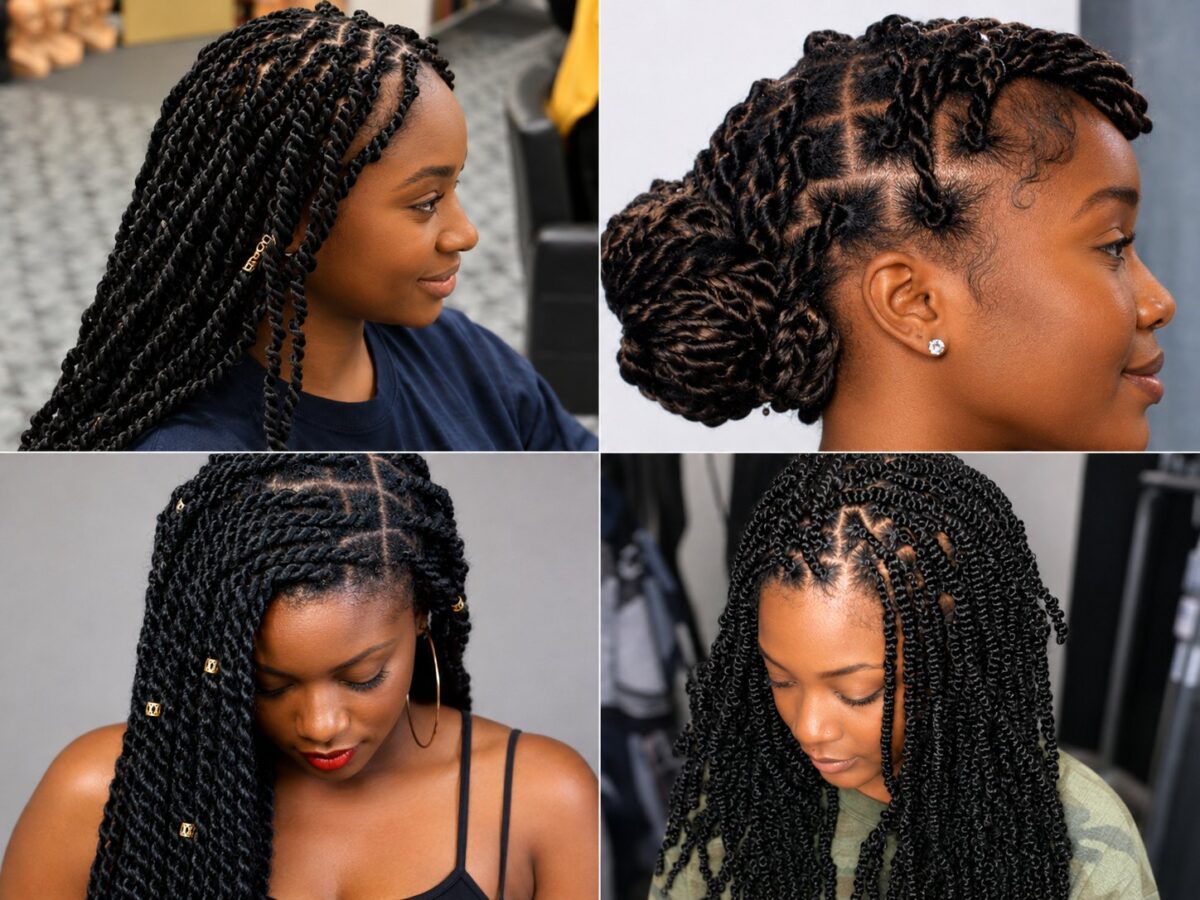
Why twists are their own discipline
Fewer crossings means less pull at the scalp, which makes twists the gentlest protective family there is, and the service you can offer a client whose edges have had enough of braids for a while.
It also makes them the most texture-dependent work on the menu. The same twist on 4C, on 3B and on heat-trained hair gives three completely different results. A twist specialist reads the hair first and chooses the approach second, and that judgement is what this certification builds, alongside passion, Senegalese, kinky and spring twists.
Why students choose Celegant
- Texture literacy taught as a module of its own
- Four premium specialty services, each with its own practice set
- The lowest-tension protective family in braiding
- A professional skills certificate, not a provincial licence
Course facts
- Level
- Specialist. Open to experienced braiders and to Foundations graduates
- Format
- In person, Edmonton
- Language of instruction
- English
- Duration
- 8 weeks, 5 modules, 25 lessons
- Schedule
- Saturdays and Sundays, 3:30pm to 6:30pm
- Class size
- Maximum 8 students, 2 instructors
- Location
- Unit 316, 8925 51 Ave NW, Edmonton, AB T6E 5J3
- Contact hours
- 48 supervised hours
- Kit
- Mannequin head with human hair, tripod stand, hair clips, rat tail comb and braiding hair, included at no extra cost
- Certificate
- Professional Specialist Certificate in Twists
- Tuition
- $1,997 CAD
- Next intake
- 1 June 2027
Hair types worked with: water wave and Freetress, Marley and kinky, spring and bomb twist hair, and Kanekalon. You practise on a mannequin. We do not use live models. Assessment is a five-part capstone taken in person in the final week.
To complete the certification you need at least 80% attendance and at least 70% on your assessments, which are assignment based. There is no deposit. You can pay in full, or split the cost into 4 interest-free instalments with Afterpay at the Square checkout, at no extra cost to you.
Tuition, published openly
$1,997CAD
- Early-bird $1,497 first 5 registrations, code TWISTS at checkout
- Pay in full, or split it into 4 interest-free instalments with Afterpay at the Square checkout
- $42 per supervised contact hour
Who this certification is for
Your twists unravel and you do not know why. There is a structural reason, and once you understand how the wind and the hair’s own coil lock together, you can diagnose it on any head instead of guessing.
Your twists look great on one client and mediocre on the next. That is texture, and it is not your technique failing. Module 2 exists entirely to make texture predictable rather than a surprise.
Clients are asking for passion twists and you are improvising. Passion twists depend almost entirely on the hair choice and the wrap technique. Both get a full demo-intensive lesson.
You want a service to offer clients who need a break from braids. Twists put less tension on the scalp than any braid. If you can only offer braids, you lose the client for a few months every time their edges need rest. This is how you keep them.
You want repeat bookings rather than long single services. Twists, twist-outs and refreshes are the most repeat-friendly category in braiding.
You are already good at braids and your twists feel like an afterthought. They are a different discipline. This treats them as one.
New to this? If you have never built a two-strand twist that holds, we would point you at the Celegant Foundations In-Person Braiding Intensive first. It is our recommended starting point for beginners, not a gate. There is no entry requirement for this certification. If you already braid to a professional standard, you can apply straight to it, and if you are not sure which is right for you, come and talk to us.
What you will be able to do at the end
Look at a client’s hair, know how a twist will behave on it, choose the right hair to pair with it, and install a full head that holds, in whichever of the four premium twist services they booked.
- Explain twist structure and mechanics well enough to troubleshoot any twist failure, not just the ones you have seen
- Predict how a given texture and a given hair choice will affect look, hold and longevity, and say so in a consultation before the client sits down
- Control the three variables that decide every twist, direction, tension and section size, held consistent across hundreds of twists
- Install full-head two-strand twists on natural hair, evenly, comfortably and lasting
- Execute flat twists cleanly along a part, the foundation of updos, mohawks and half-up looks
- Join extension hair with a start that is invisible and does not slip
- Create a defined twist-out with real curl definition and no frizz on the unravel
- Install all four premium specialty services: passion twists, Senegalese rope twists, kinky and Marley twists, and spring and bomb twists
- Seal, finish, maintain and safely take down each one, by hair type
- Leave with a verifiable Professional Specialist Certificate in Twists, a tiered price menu and a six-image portfolio
The four premium specialty services
| Detail | Passion twists | Senegalese, rope | Kinky and Marley | Spring and bomb |
|---|---|---|---|---|
| Hair used | Water wave and Freetress | Kanekalon | Marley and kinky textured hair | Pre-textured spring and bomb hair |
| The look | Soft bohemian texture | Sleek and polished | Blends most naturally with coily hair | Light, springy, informal |
| What it tests | Wrap technique and even bohemian texture | Even tension along a smooth rope | Fullness and natural blend | Speed and clean starts |
| Relative install time | Longer | Longer | Moderate | Fastest of the four |
| What you practise | Six twists, best three reviewed | Six twists judged on smoothness | Six twists reviewed for blend | A full section |
Passion twists
- Hair used
- Water wave and Freetress
- The look
- Soft bohemian texture
- What it tests
- Wrap technique and even bohemian texture
- Relative install time
- Longer
- What you practise
- Six twists, best three reviewed
Senegalese, rope
- Hair used
- Kanekalon
- The look
- Sleek and polished
- What it tests
- Even tension along a smooth rope
- Relative install time
- Longer
- What you practise
- Six twists judged on smoothness
Kinky and Marley
- Hair used
- Marley and kinky textured hair
- The look
- Blends most naturally with coily hair
- What it tests
- Fullness and natural blend
- Relative install time
- Moderate
- What you practise
- Six twists reviewed for blend
Spring and bomb
- Hair used
- Pre-textured spring and bomb hair
- The look
- Light, springy, informal
- What it tests
- Speed and clean starts
- Relative install time
- Fastest of the four
- What you practise
- A full section
Skills and services this certification covers
Foundational twist work
- Full-head two-strand protective twists on natural hair
- Flat twists, also called scalp twists, along a part
- Rope twists
- Twist-outs and defined texture styles
- Extension twists with a seamless join
Styling, finishing and lifecycle
- Updos, buns and half-up looks built on flat twists
- Edge styling and baby hair on twist styles
- End sealing by hair type, hot water for smooth twists and alternatives for textured
- Trimming flyaways for a clean finish
- Aftercare and hairline refreshes between installs
- Safe takedown by hair type, plus detangling and scalp recovery counsel
The curriculum, module by module
Five modules across eight weeks, opening with texture literacy rather than technique, because that is what actually separates twist work from braid work.
Welcome and Specialist Orientation
Week 1, first session. Why twists are their own discipline, plus something no other track needs: building a labelled texture inventory.
- What you learn. What the credential certifies and what it does not. Why twists are their own discipline rather than a variation on braiding, wound rather than interwoven, which means different rules for hold, tension and failure. Then station setup, and something no other track needs: building a texture inventory. Water wave, Marley and kinky, spring and Freetress, Kanekalon, all labelled, understood and within reach, because hair choice is half the result in twist work.
- Why it matters. Twists are the most texture-dependent style you will offer. The same technique reads completely differently on different hair, and a specialist who cannot name and choose hair is guessing.
- What you practise. A baseline video of three current twists. The entry-standard checklist run live: equal sections, consistent direction, even tension, a twist that holds, a smooth start at the scalp. And you assemble and label a texture inventory of at least three hair types.
- The professional outcome. You know what you are fixing first, and you have a labelled hair inventory you will use for the rest of the track.
Twist Theory and Texture Literacy
Weeks 1 and 2. Twist mechanics, a twist deliberately unravelled so you can see the failure point, then texture, the three control variables, shrinkage and hair choice.
- What you learn. Twist mechanics first: the two-strand structure, why the wind direction and the hair’s own coil lock together, why twists are gentler at the scalp than braids, and the structural family of two-strand, flat and rope. Then a twist is deliberately unravelled in front of you so you can see the failure point. Then texture: how coily, curly, wavy, straight and relaxed hair each hold a twist, how density and length change section size and hair choice, and how to run the texture conversation in a consultation without over-promising. Then the three control variables: direction, and why mixed direction ruins a head, tension zones, and section size and its effect on count, install time, fullness and longevity. Then shrinkage and longevity, how natural hair draws up, why one client gets three weeks and another six, and a deep dive on hair choice by look, weight and wear. Finally the prep-and-section routine that precedes every style in the rest of the course.
- Why it matters. This is the module that makes you able to answer ‘how long will these last’ honestly, and to predict a result before you commit three hours to it.
- What you practise. One two-strand twist, one flat twist and one rope twist, side by side, to feel the structural difference. The same twist built on two contrasting textures and compared. Two sections at different section sizes with perfectly consistent direction. The same small style in two different hair choices, compared for weight and look.
- The professional outcome. A natural-hair section of twelve to fifteen twists with perfectly consistent direction, uniform section size, even tension and a clean prep routine, timed and presented. This is the base control everything later depends on.
Protective Two-Strand and Flat Twists
Weeks 3 and 4, the heaviest module in the track. Full-head two-strand work, flat twists, the seamless extension join, twist-outs, styling, speed and the five faults.
- What you learn. Full-head two-strand twists: layout, sectioning, a clean start at the scalp with no knot or bump, and keeping size, tension and direction uniform across hundreds of twists. Then flat twists, twisted flat along a part with scalp hair fed in, the twist equivalent of a cornrow and the foundation of every twist updo. Then the seamless extension join: wrap-in and braid-anchor starts, hiding the join at the scalp, matching extension amount to natural density, and securing the start so it does not slip. Then twist-outs: section size and product for definition, drying and setting, unravelling without frizzing, separating and fluffing for volume, and re-twisting for multi-day wear. Then styling: half-up, bun and ponytail looks, flat twists as an updo foundation, edges and baby hair. Then speed, built from the wind rhythm rather than rushing, plus troubleshooting the five common faults of unravelling, direction drift, lumpy joins, uneven sizing and frizz. Then full-head sequencing.
- Why it matters. These are the everyday paid services of a twist specialist and the gentlest long-wear work a braider can offer. Flat twists in particular unlock a whole styling menu that pure two-strand work does not.
- What you practise. A quarter-head of two-strand twists judged on uniformity. Three flat twists along a part, kept flat and even. Six extension twists judged on join invisibility and secure starts. A twist-out twisted, set, unravelled and fluffed. A completed section styled two ways with polished after-photos. A timed section, efficiency drills, then a fresh timed section, plus one fault deliberately created and corrected in front of the instructor.
- The professional outcome. A half-head of two-strand twists with extensions, in a recognised protective style, with uniform size, consistent direction, seamless joins and even tension. This is the central technical proof of the certification.
Specialty Twist Services
Weeks 5 and 6. Passion, Senegalese, kinky and Marley, and spring and bomb twists, each with its own hair, technique, install time and price, then finishing and lifecycle.
- What you learn. Four distinct services, each with its own hair, technique nuance, install time and price. Passion twists: what actually defines them, water wave and Freetress hair and the soft bohemian texture, hair prep and amount per twist for the signature fullness, the wrap technique and a secure invisible start, and how to keep the bohemian texture even without it reading as messy. Senegalese rope twists: two smooth strands wound under firm even tension, Kanekalon prep for the sleek finish, keeping the rope smooth root to tip, a clean tapered end, and sealing for a polished result. Kinky and Marley twists: the textured hair that blends most naturally with coily hair, the technique adjustments textured hair demands, building fullness and natural volume, and the two-strand versus wrapped methods. Spring and bomb twists: pre-textured, lighter, faster to install, and the ones that let you say yes to almost any twist request. Then finishing: end sealing by hair type, trimming flyaways, edges and baby hair, and the photo finish. Then the full lifecycle: aftercare by style, hairline refreshes, safe takedown by hair type, and detangling and scalp recovery counsel after removal.
- Why it matters. These are the styles clients screenshot and travel for. Each is a separate line on your price menu with a separate rate.
- What you practise. Six passion twists, with the start of your best three and the finished texture reviewed. Six Senegalese rope twists judged on smoothness and even tension. Six kinky or Marley twists reviewed for natural blend and fullness. A spring or bomb twist section. One specialty section finished completely and photographed. A safe specialty takedown and a hairline refresh.
- The professional outcome. A complete specialty twist style of your choice, installed to the service-ready standard, finished, styled and presented.
Certification Capstone and Becoming a Specialist
Weeks 7 and 8. Tiered pricing adjusted for longer install times, portfolio work that captures movement and texture, then the capstone.
- What you learn. Pricing in tiers, natural-hair twists, extension twists and specialty styles, with size, length and hair cost as factors, and premium specialty services priced accordingly. The time-to-rate calculation, adjusted for the longer install times twists carry. Then a portfolio built on the shots that sell twist work: the join or blend, the finished fullness, texture detail, and before and after, photographed to capture movement and texture rather than flattening it.
- Why it matters. Charging one flat rate across everything from a simple natural-hair twist to a full passion twist install leaves real money on the table.
- What you practise. A full tiered twist price menu for your own market, shared with the cohort. A six-image portfolio. Coached practice on your weakest area.
- The professional outcome. A menu, a portfolio, a credential and a one-to-one debrief.
What a twist specialist can do that a braider cannot
Signature techniques you will own
Direction discipline
Perfectly consistent wind direction across a full head. Mixed direction is the single most common thing that makes an otherwise good twist install look amateur, and it is invisible to the person doing it.
The invisible extension join
A wrap-in or braid-anchor start hidden at the scalp, secure enough not to slip, with the blend maintained down the length.
The passion twist wrap
The specific wrap and start that produce soft bohemian texture reading as deliberate rather than messy.
Texture prediction
Looking at a client’s hair and knowing, before you begin, how the twist will sit, how long it will hold and which hair to pair with it.
The four specialty services, lesson by lesson
The download sets out all five modules, the hair guide, the tools list and the assessment standard. No payment on a first visit.
What you will actually be doing in the room
Because twists are the most texture-dependent work in the program, key techniques are demonstrated on more than one hair texture wherever possible, and correction time is concentrated on the join and the finished texture, the two things students most need convincing about.
- One two-strand, one flat and one rope twist, compared structurally
- The same twist built on two contrasting textures
- Two sections at different section sizes, direction held perfectly consistent
- The same style in two different hair choices, compared for weight
- A natural-hair section of twelve to fifteen twists, timed
- A quarter-head of two-strand twists
- Three flat twists along a part
- Six extension twists judged on join invisibility
- A full twist-out: twisted, set, unravelled and fluffed
- A completed section styled two ways with after-photos
- A timed section, drills, then a re-timed section
- One fault created and corrected live
- Six passion twists
- Six Senegalese rope twists
- Six kinky or Marley twists
- A spring or bomb twist section
- A complete specialty style, finished and photographed
- A safe takedown and hairline refresh
Tools and materials
- Water wave and Freetress hair for passion twists and boho texture
- Kanekalon for Senegalese rope twists
- Marley and kinky hair for the most natural-blending twists
- Spring and bomb twist hair, pre-textured
- Rat-tail comb and sectioning clips
- Edge tool
- Hot-water setup and alternatives for end sealing by hair type
- Small scissors for trimming flyaways
- Spray bottle for prep
- A timer
- A mannequin at working height
- A camera or phone for join close-ups and texture shots
Your kit comes with the course. Mannequin head with human hair, tripod stand, hair clips, rat tail comb and braiding hair, included at no extra cost. It is yours to keep. If you already own some of it, bring what you have and we will supply the rest.
You are given a hair type reference chart. It sets out passion, Senegalese, Marley and spring twists side by side on the fibre each uses, how the finished style behaves and what to watch for, then matches fibre to the client in front of you, including fine hair, tightly coiled hair and previously damaged edges. It also covers size against time against longevity, and how much fibre to buy.
Assessments and what you leave with
Module skills submissions. Module 2, base control, and module 3, the half-head extension install with three join close-ups, are reviewed in person. Module 3 is the central technical proof.
The final capstone, assessed in person, in five parts
- Technical. A full or three-quarter-head twist style with uniform size, perfectly consistent direction, even tension with a protected hairline, and, if using extensions, seamless invisible joins.
- Specialty element. The style must be a recognised specialty service, passion, Senegalese, kinky or Marley, or spring, or a styled protective twist finished with a twist-out or updo.
- Documentation. A sectioning plan, three join or texture close-ups, the finished style from top, front and side, and your total timed install.
- Service package. A mock consultation form including the texture and longevity conversation, a tiered twist price menu, and a personalised aftercare sheet.
- Reflection. Your biggest improvement since the week one baseline, and the twist style you most want to master next.
On passing you receive the verifiable Professional Specialist Certificate in Twists, a six-image twist portfolio, a tiered price menu written for your own market, and a consultation form covering texture and longevity together with an aftercare sheet.
Coming back for a second specialty. 20% off your next specialty certification when you enrol within 90 days of completing one. That is a standing offer, not a launch promotion.
Who teaches this

Dr. Tina
Lead Instructor
Dr. Tina is a Master Braider and the Lead Instructor of Celegant Braiding Academy. She has braided more than 3,500 clients since 2016, has run her own salon since 2015, and teaches every Academy program personally, with a co-instructor alongside her.
- Master Braider
- Braiding clients since 2016, and running her own salon since 2015
- Experienced braider and loctician
- Experienced wig maker, and wig and weave installer
- A working braider at Celegant Hair Edmonton, not only an owner
Why that matters for this particular certification. Twists are a published service at Celegant Hair Edmonton, the professional braiding salon at the same address, and Dr. Tina writes about protective styling and Afro-textured hair care under her own name. Texture literacy, the core of this track, is the part of the job she has been publishing about for years, not a module she picked up to teach.
Dr. Tina teaches from experience rather than from theory, with a real example behind every point, and she adapts her pace and her explanations to how each student in the room actually learns. Her approach in her own words is on the About page.
Tuition and payment
Full certification
$1,997CAD
- Early-bird $1,497 first 5 registrations, code TWISTS at checkout
- Pay in full, or split it into 4 interest-free instalments with Afterpay at the Square checkout
- $42 per supervised contact hour
All prices include GST. The figure above is what you pay.
No deposit, and no interest. Pay in full, or split the cost into 4 interest-free instalments with Afterpay at the Square checkout, at no extra cost to you. Afterpay is offered through Square. You choose it at the payment step inside the secure Square checkout, not on a separate page.
Funding. See tuition, instalments and funding options.
How enrolment works. Download the curriculum first. If it is right, you can reserve your seat from there. No first-visit checkout.
Schedule and location
In person only. Twist joins and finished texture are the two things students most doubt will work on real hair, which is exactly why they are demonstrated live, on more than one texture, with hands-on correction.
The specialty certifications run two afternoons a week: Saturdays and Sundays, 3:30pm to 6:30pm. The next intake is 1 June 2027. Contact hours, class size and the address are all in the course facts above and in the footer of every page.
Finding us. Unit 316 is in building 3. It is not on a third floor. The site is single storey, so there are no stairs and no lift between the car park and the classroom. Parking is ample and includes two designated accessible spaces, and the salon and store are wheelchair accessible.
The washroom is not a wheelchair-accessible washroom. A wheelchair fits inside it, but there is not enough clearance to turn around and there are no grab bars. We would rather tell you that now than have you find out on the day.
Where this leads next
Single Braids Specialist, knotless and regular is the obvious pairing. Braids and twists together let you alternate services for the same client year-round instead of losing them when their edges need a break.
Crochet Specialist delivers twist and braid looks in a fraction of the install time. If twists are the long service, crochet is the fast one, and the two balance a schedule.
Locs Specialist builds on the same hands. Two-strand twist starts are one of the core loc creation methods, so your twist control transfers directly.
Questions braiders actually ask
Are twists really gentler on hair than braids?
Structurally, yes. A twist is wound rather than interwoven, so there are fewer crossings and generally less pull at the scalp. That is a real advantage and it is why twists are the sensible recommendation for a client whose edges need a rest. But gentler is not risk-free: a twist installed at too much tension at the root will still cause damage. Tension zones are taught in module 2.
This guidance is educational and is not medical advice.
What is the actual difference between passion, Senegalese, kinky and spring twists?
Mostly the hair, and then the technique that hair demands. Passion twists use water wave or Freetress hair wrapped for a soft bohemian texture. Senegalese are rope twists in Kanekalon, wound smooth under firm even tension for a sleek finish. Kinky and Marley use textured hair that blends naturally with coily hair for the most natural look. Spring and bomb twists use pre-textured, lighter hair that installs faster. Each gets its own lesson, its own practice set and its own price line.
Why do my twists unravel?
It is structural, not bad luck. A twist holds because the wind direction and the hair’s own coil lock against each other. When they do not, whether from the wrong direction for the texture, a section that is too large, hair too smooth for the method, or a start that was not secured, it releases. In module 2 the instructor builds a twist and then deliberately unravels it so you can see the exact failure point, then shows the fix.
Can I do twists on relaxed or heat-trained hair?
Yes, with adjustments, and that is precisely the judgement module 2 builds. Relaxed and heat-trained hair holds a twist differently from coily hair because there is less natural coil to lock against. You will build the same twist on two contrasting textures and compare the result, so the difference is something you have felt rather than read.
Do you teach twist-outs, or just twists?
Twist-outs get a full lesson: section size and product for definition, drying and setting, unravelling without frizzing, separating and fluffing for volume, and re-twisting for multi-day wear. It is a separate service on natural hair with no extensions at all, and worth having on a menu.
How do I tell a client how long their twists will last?
Honestly, and with reasons. Longevity comes down to technique, hair type, aftercare and lifestyle. Module 2 covers shrinkage and longevity so you can set an accurate expectation in the consultation instead of hoping. The capstone consultation form includes that conversation as a required element.
My flat twists lift off the scalp. What am I doing wrong?
Usually the feed: picking up uneven amounts of scalp hair as you go, or not keeping the twist close as you travel along the part. Module 3 covers the technique and shows an even flat twist beside a lifting one, close up.
Do I need to take Foundations first?
No. There is no entry requirement for this certification. Anyone with enough experience can apply directly. Foundations is our recommended starting point for beginners, not a gate. What this program does assume is that you can already build a two-strand twist that holds. If you cannot yet, start at Foundations.
Is this a licence to braid hair professionally in Alberta?
No. Celegant issues a professional skills certificate, not a provincial trade certificate, licence or government credential. Read the honest answer on Alberta’s rules.
What if I miss a session?
See refunds and rescheduling for the current policy.
What this credential is, and what it is not
Celegant Braiding Academy issues a professional skills certificate. It is awarded by us, based on assessed practical work. It is not a provincial trade certificate, not a government licence, and not an apprenticeship credential.
In Alberta, Hairstylist is a compulsory-certification designated trade. Braiding is not named specifically in the government sources we reviewed, and we will not guess on your behalf. The authoritative answers live with the province:
- Restricted Activities List, Hairstylist, Alberta Apprenticeship and Industry Training: tradesecrets.alberta.ca
- Barber and Hairstylist certification in Alberta: alis.alberta.ca
- Apprenticeship and Industry Training Client Service Offices: call them and ask about your exact situation.
If your plan is to cut and chemically treat hair as a licensed hairstylist, the apprenticeship route is the one you want, and we will tell you that plainly. Our program is for braiding, twisting, locing, crochet and install work, and for the business skills that go with them.
Educational information only. This is not legal advice.
Scalp and hair safety. Tension, traction and scalp-health guidance in this program is educational and is taught for the safe practice of protective styling. It is not medical advice. Refer clients with hair loss, scalp conditions or suspected reactions to a physician or another qualified professional.
Ready?
Download the full curriculum: every module, every lesson, the four specialty services, the hair guide and the assessment standard.