
Foundations, in person, Edmonton
Celegant Foundations: the In-Person Braiding Intensive
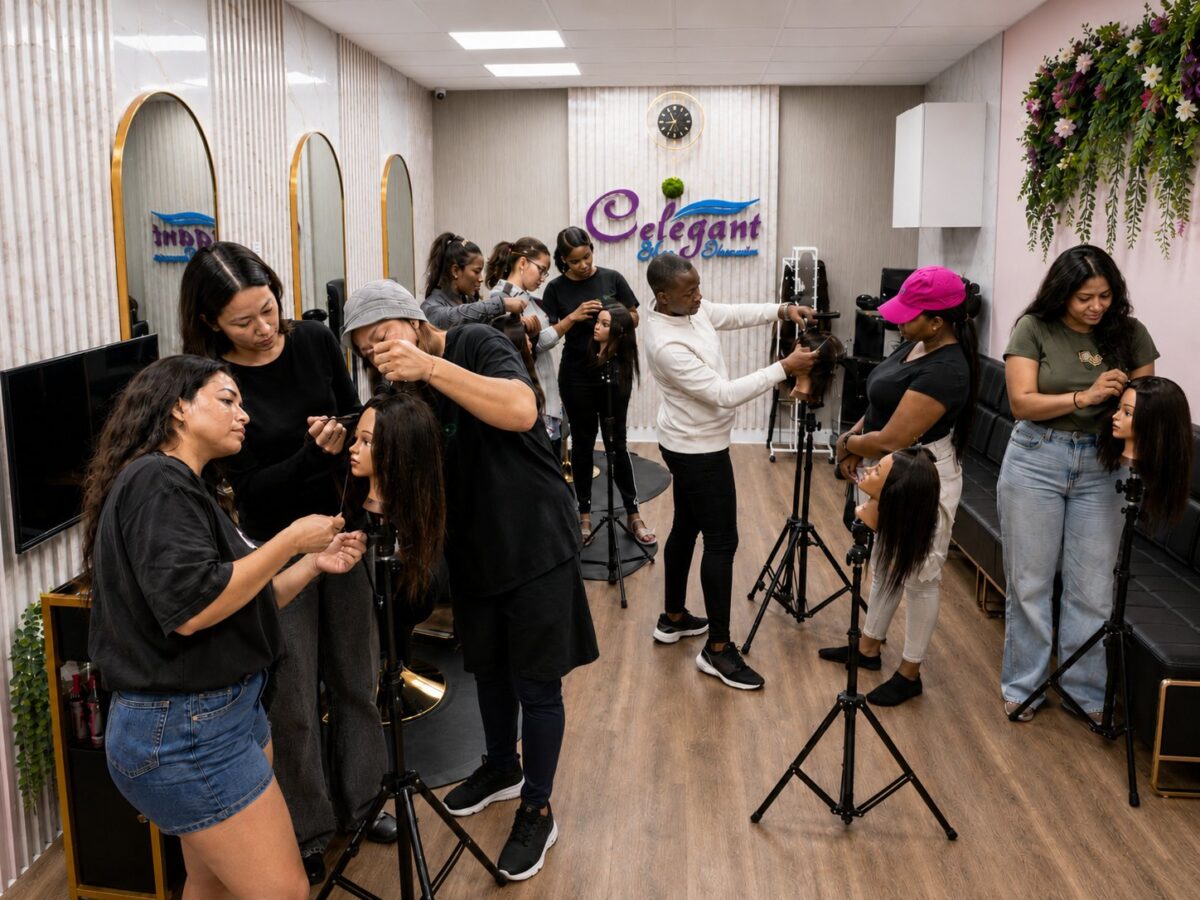
Ten weeks, sixty supervised contact hours, and seventeen modules that start with how to hold the hair. By week ten you will have braided a full head of cornrows, both knotted and knotless single braids, twists, a crochet install, a braided install foundation and your first starter locs, with someone watching your hands the entire time.
What Foundations gives you
- No experience required, and no licence needed to enrol
- Every session hands-on and coached, never watched
- An assessed in-person capstone, not a certificate for attendance
- Free, and no payment is taken on this website
If any of these sound like you, you are in the right place
- “My parts are always bigger on one side than the other.”
- “I can braid, but it takes me six hours and my arms give out.”
- “I’ve watched a hundred tutorials and I still can’t get the tension right.”
- “I braid my kids’ hair, my sister’s hair, my friends’ hair, and I’ve never charged anyone a dollar.”
- “I’m a licensed stylist and my diploma barely mentioned textured hair.”
- “I don’t know where to start and I don’t want to be the worst person in the room.”
None of those is a talent problem. Every one of them is a coaching problem, and coaching is the only thing a video cannot do.
You can learn the theory anywhere. You cannot learn the hands anywhere.
There is a version of this craft you can buy online for fifty-nine dollars. It will show you a clean part and a feed-in, where extension hair is added a little at a time so the braid starts small and flat, and it will be perfectly accurate. What it will never do is stand behind you at 5:40 on a Tuesday, watch you pull half a millimetre too tight, and stop you before it becomes a habit you keep for the next ten years.
Braiding is a motor skill. Motor skills are corrected by someone who can see your hands, in real time, repeatedly. That is what the supervised hours are for.
Coached, not watched
Every session is hands-on. You are working on a mannequin head while an instructor moves between stations and corrects what she sees.
Errors caught early
Module 8 has an entire lesson on recognising and fixing your own mistakes mid-braid, because the difference between a beginner and a professional is not that professionals do not make errors. It is that they notice.
A cohort, not an inbox
You start with a group and you finish with them. There is no version of this where you drift away in week three because nobody noticed.
What Foundations costs
Tuition
$1,997CAD
- Early-bird $1,497 first 5 registrations, code FOUNDATIONS at checkout
- Pay in full, or split it into 4 interest-free instalments with Afterpay at the Square checkout
- $33 per supervised contact hour
Every one of those supervised hours is in a room with an instructor who can see your hands.
All prices include GST. There is no deposit: pay in full, or split the cost into 4 interest-free instalments with Afterpay at the Square checkout, at no extra cost to you. See tuition and funding for the full breakdown.
Who this is for
- Complete beginners. Module 1 assumes you have never held a rat-tail comb. Nothing later assumes otherwise.
- Self-taught braiders. You have speed and no consistency. We rebuild grip, tension and parting from the ground, then give you back your speed.
- Career changers. Two afternoons a week for ten weeks, 3:30pm to 6:30pm. It fits around shift work, study and a school run.
- Licensed stylists. Textured-hair braiding was not in your diploma. It can be on your service menu in ten weeks.
- Salon owners. Send a stylist, or come yourself. Then read the funding page before you pay for it.
- Newcomers to Canada. You know how to braid. What you need is Canadian consultation and sanitation standards, CAD pricing, and a credential with your name on it.
- Parents and caregivers. You are welcome. You will leave able to do your child’s hair properly, and you will understand why the tension matters.
Who this is not for
- Anyone under the minimum age.
- Anyone whose goal is an Alberta hairstylist licence. Braiding certification is not a route to that credential and we will not tell you otherwise. The apprenticeship is what you want. Start at tradesecrets.alberta.ca.
- Anyone who cannot commit to two afternoons a week for ten weeks. The hands-on weeks are tightly packed and missing them costs you more than it would on a video course.
The practical details, all of them
The format, address, schedule, length, structure, class size, certificate, tuition and next intake are all set out in the key facts panel at the foot of this page. The level there reads beginner-complete: by week ten you can take each of the six styles from consultation through to a finished, sealed head on your own, safely and to standard. Speed is what you build afterwards. Here is everything else.
- Practice
- Mannequin heads throughout. No live models are used
- Home practice
- Expected between sessions. The style weeks move quickly and practice is what makes them stick.
- Assessment
- An in-person capstone in the final week
- Online version
- There is none. Foundations is in person only.
- Class size
- Maximum 8 students, 2 instructors
- Step-free access and parking
- Unit 316 is in building 3, not on a third floor. The site is single storey, so entry is step-free. Parking is ample and includes 2 designated accessible spaces.
- Washroom
- A wheelchair fits, but there is no turning clearance and no grab bars, so it is not a wheelchair-accessible washroom.
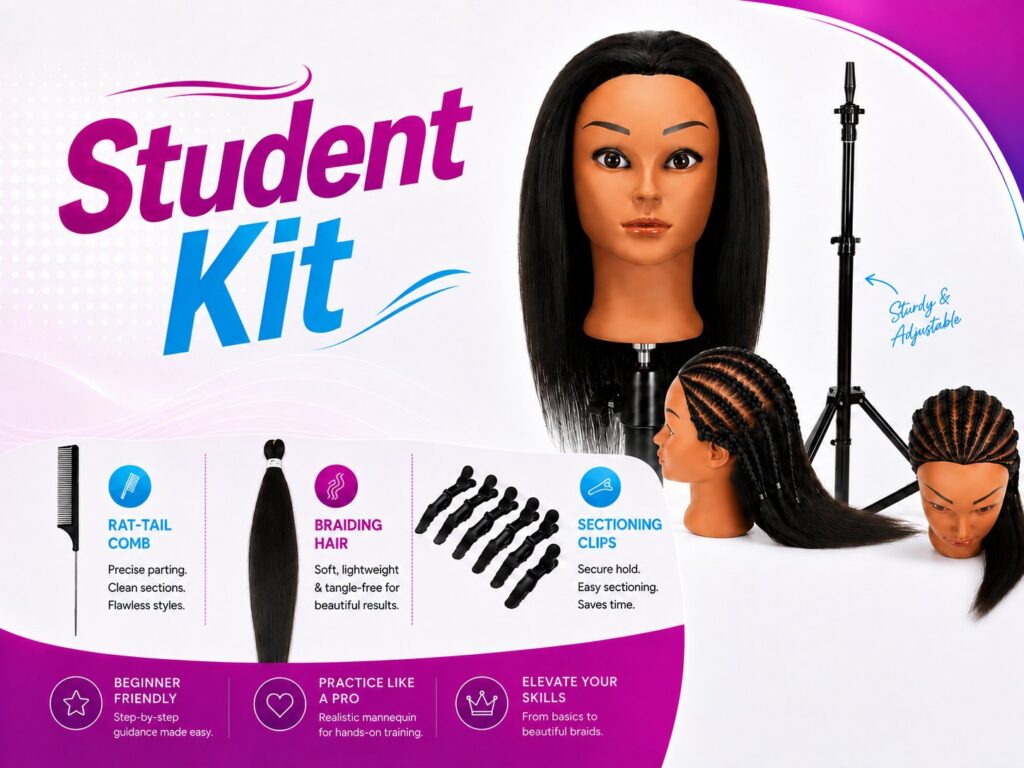
The kit is included in your tuition and it is yours to keep.
If something here does not work for your schedule, ask us. Talk to a braider.
Your ten weeks
This is the designed schedule. Your instructor can flex the boundaries if a cohort needs longer on a technique. We would rather you left able to do it.
Setting up and staying safe
Modules 1 to 2, 8 lessons. You meet the cohort, build your kit and set up your station, then go straight into professional sanitation: tools, workspace, hands, and the scalp and skin conditions that mean pause the service and refer the client. Nothing glamorous. Everything that keeps you and a client safe.
Hair science, consultation and tools
Modules 3 to 5, 12 lessons. Hair structure and growth cycles. Hair types, textures and porosity, and what each needs. Scalp health from a braider’s point of view. Then the consultation framework: assessment, screening for cautions, aligning what a client wants with what their hair can do, and documenting a service plan. Then the toolkit, the products, and how to judge braiding hair by quality and quantity.
Salon skills and preparation
Modules 6 to 7, 9 lessons. Workstation and service flow. Detangling and handling hair without breaking it. Client comfort and positioning through a long service. Then cleansing, conditioning, stretching and blow-drying for a smooth braiding surface, adapting prep to different hair types, and preparing extension hair.
The hands, and the parts
Modules 8 to 10, 15 lessons. The heaviest technical week in the course. Grip and hand position. The three-strand foundation. Tension control. Rhythm and consistency. Recognising and correcting your own errors mid-braid. Then parting: the clean part, box, brick-lay and triangle parts, brick-lay being the one that offsets every row like bricks in a wall, planning and mapping a full head, and the step-back check, where you stand back from the head to see whether the parts line up before you carry on. Then three-strand on the head, the two-strand twist, the rubber-band grip method and the basic method for adding extension hair.
Cornrows
Module 11, 5 lessons. The underhand cornrow motion and feeding hair as you go. Straight-backs. Then a full head, sequenced and paced with quality checkpoints along the way. Then cornrows with extensions, the basic feed-in. Then finishing: securing ends, neatening the hairline, protecting the edges.
Single braids, knotted and knotless
Module 12, 6 lessons. Both starts, taught properly. The traditional knotted single braid. The knotless single braid and its smooth transition. Box and triangle parting. C (crescent) parting. Then braiding down, finishing, and the single-braid check that tells you whether the set is even.
Twists
Module 13, 4 lessons. Full-section two-strand twists on natural hair. Adding extension hair for length and fullness. A first passion or Senegalese-style twist. Finishing twists, and an honest picture of where the Twists Specialist certification takes this next.
Wigs and weaves, then crochet begins
Modules 14 to 15, 8 lessons. First session: safety first and the full install picture, the braided foundation, the basic weft and sewing stitch, and glueless wigs. Second session: the crochet base and the latch hook, a small hooked needle that draws hair through the braid, and the invisible knot, tied so nothing shows at the scalp.
Crochet finishes, then locs
Modules 15 to 16, 8 lessons. First session: installing and shaping a simple curly crochet style, and finishing it cleanly. Second session: how hair locks and the stages of the loc journey, starter locs with comb coils, starter locs from a two-strand twist, and a first retwist, taught with the cultural respect a loc client deserves.
Finishing, aftercare and your capstone
Module 17, 5 lessons. Finishing and sealing to a professional standard. Edge and hairline styling. Aftercare counsel: wear time, safe takedown, and the conversation that gets a client to rebook. Capstone preparation with coached practice on your weakest area. Then the Foundations Capstone, assessed in person, and a one-to-one conversation about which specialty is right for you.
Download the Curriculum for the full lesson-by-lesson version.
Seventeen modules. Seventy-six lessons. Sixty hours in the room.
Early-bird tuition applies to the first registrations in each cohort. Instalment options are available.
Every module, and what it gives you
Seventeen modules. For each one: what is covered, and what it actually changes about your work.
Welcome & Program Orientation
Week 1. What is covered: The program structure and what the credential certifies, setting up and organising your personal braiding kit and station, the practice commitment an in-person intensive asks for, and how to get help during and between sessions.
- What it gives you: You walk in nervous and walk out belonging to a cohort, with a working station, so that no practical time is lost later in the course.
Health, Safety & Sanitation
Week 1. What is covered: Why sanitation matters, tool and station sanitation, personal and hand hygiene, scalp and skin awareness, and product safety and a hygienic workflow.
- What it gives you: The standard that separates a professional from someone braiding on a kitchen chair, and the confidence to recognise a scalp condition and refer instead of guessing.
Hair & Scalp Science Essentials
Week 2. What is covered: Hair structure and the growth cycle, hair types and textures and what each needs, scalp health for braiders, and applying hair science to braiding decisions.
- What it gives you: You stop choosing tension, product and style by feel and start choosing them for a reason you can explain to a client.
Client Consultation Basics
Week 2. What is covered: The consultation framework, hair and scalp assessment, managing expectations, and documenting the service plan.
- What it gives you: The conversation that prevents the argument. You leave with your own consultation form and the language to say no to a style that will damage someone’s hair.
Tools, Products & Materials
Week 2. What is covered: The braiding toolkit, products for prep, hold and finish, understanding braiding hair, human, synthetic and blends, and judging quality and estimating quantity.
- What it gives you: You stop over-buying and under-buying hair, and you can tell a client why the cheap pack is costing them their edges.
Foundational Salon Skills
Week 3. What is covered: Workstation and service flow, detangling and hair handling, client comfort and positioning, and professionalism in the chair.
- What it gives you: The difference between a service someone endures and one they rebook. Also the reason your own back and shoulders survive a five-hour install.
Hair Preparation for Braiding
Week 3. What is covered: Cleansing and conditioning for braiding, stretching and blow-drying, adapting prep to hair type, preparing extension hair, and the complete prep workflow.
- What it gives you: Most bad braid jobs are bad prep jobs. This is where a finish stops looking homemade.
Basic Braiding Theory & Hand Skills
Week 4. What is covered: Grip and hand position, the three-strand foundation, tension control, rhythm and consistency, and error recognition and correction.
- What it gives you: The muscle memory every single style in this course sits on top of, and the ability to feel a mistake before you can see it.
Sectioning & Parting Foundations
Week 4. What is covered: The clean part, box, brick-lay and triangle parts, planning and mapping the head, and consistency and the step-back check.
- What it gives you: Even parts. This is the single thing clients notice first and the single thing self-taught braiders most often get wrong.
Core Braiding Foundations
Week 4. What is covered: Three-strand on the head, the two-strand twist, the rubber-band grip method, adding extension hair by the basic method, putting it together, and coached practice, feedback and readiness.
- What it gives you: The point where the separate skills become one motion, and the honest readiness check before the style weeks start.
Beginner Cornrows
Week 5. What is covered: The cornrow motion, straight-back cornrows, cornrowing a full head, cornrows with extensions and the basic feed-in, and finishing cornrows.
- What it gives you: A full head of even, flat straight-backs: the foundational style, the base for feed-ins, sew-in foundations and crochet, and the first thing you will ever be paid for.
Beginner Single Braids, Knotless and Regular
Week 6. What is covered: What single braids are and the two starts, the traditional knotted braid, the knotless braid, box and triangle parting, C (crescent) parting, and braiding down, finishing and the single-braid check.
- What it gives you: Both starts in your hands, not just the one you find easier, and three parting systems, which is what lets you say yes to what a client actually asks for.
Beginner Twists
Week 7. What is covered: Two-strand twists in a full section, adding extensions to twists, a first passion or Senegalese twist, and finishing twists and where the specialty takes you.
- What it gives you: The gentlest style family on the hair and one of the most repeat-friendly on a service menu.
Beginner Wigs & Weave Installation
Week 8. What is covered: Safety first and the install picture, the braided foundation, basic weft and the sewing stitch, and glueless wigs and where the specialty takes you.
- What it gives you: An introduction to the highest-ticket service in the trade, taught glueless-first, with the safety principles that protect a client’s hairline.
Beginner Crochet
Weeks 8 to 9. What is covered: The crochet base and the latch hook, the invisible knot, installing a simple curly style, and finishing crochet and where the specialty takes you.
- What it gives you: The fastest protective style to install: the one that lets a new braider take bookings while their braiding speed is still building.
Beginner Locs
Week 9. What is covered: How locs work and cultural respect, starter locs with comb coils, starter locs from a two-strand twist and a first retwist, and the loc journey and where the specialty takes you.
- What it gives you: Loc literacy: enough to start a client’s locs, and more importantly enough to talk honestly with someone about a commitment measured in years.
Finishing, Sealing & Aftercare, plus the Foundations Capstone
Week 10. What is covered: Finishing and sealing techniques, edge and hairline styling, aftercare and client counsel, capstone preparation with coached practice, and the Foundations Capstone and what comes next.
- What it gives you: The polish that separates a beginner’s work from a professional’s, an aftercare sheet you wrote yourself, and the credential.
Download the Curriculum for all seventy-six lessons in detail.
Still deciding? Read the whole thing first.
The curriculum download is the full document: every module, every lesson, the tools list, the schedule and the tuition breakdown. We would rather you read it and decide this is not for you than enrol on a hunch.
The capstone
Your credential is earned, not issued for attendance. In the final week, in person, on a mannequin, or a model if you are comfortable, you demonstrate:
- A full or three-quarter head of straight-back cornrows, even and flat, including a basic feed-in section
- A patch of single braids in your choice of box, triangle or C (crescent) parting, using either the knotted or the knotless start, braided down and sealed
- A clean two-strand twist section
- Professional finishing, edge styling and sealing across your work
- A completed consultation form and aftercare sheet for a hypothetical client
Assessed on: clean parting, even tension and sizing, a protected hairline, secure finishing, and professional documentation.
To complete Foundations you need at least 80% attendance and at least 70% on your assessments, which are assignment based.
If you do not pass the assessment. You need at least 80% attendance and at least 70% on your assessments, which are assignment based. If you fall short on the assessment, you can re-sit it. Your instructor will tell you exactly which part you missed and what to practise first, and you can take it again once you are ready.
A re-sit costs $200, which is 10% of the program fee. That covers the instructor time to set up, observe and mark it. There is no limit on how many times you try.
This is separate from attendance. If you finish below the attendance standard, that is dealt with in Attendance and code of conduct, and it is the missing hours you make up rather than the assessment you retake.
Pass, and you hold the Professional Certificate in Braiding Foundations. It is also the point at which you have touched every braiding direction we teach, so you can choose a specialty on evidence rather than on a guess. Foundations is not a gate. The six specialty certifications have no entry requirement, and an experienced braider can apply to any of them directly.
What your certificate is, and what it is not
Celegant Braiding Academy issues a professional skills certificate. It is awarded by us, based on assessed practical work. It is not a provincial trade certificate, not a government licence, and not an apprenticeship credential.
In Alberta, Hairstylist is a compulsory-certification designated trade. Braiding is not named specifically in the government sources we reviewed, and we will not guess on your behalf. The authoritative answers live with the province:
- Restricted Activities List, Hairstylist, Alberta Apprenticeship and Industry Training: tradesecrets.alberta.ca
- Barber and Hairstylist certification in Alberta: alis.alberta.ca
- Apprenticeship and Industry Training Client Service Offices: call them and ask about your exact situation.
If your plan is to cut and chemically treat hair as a licensed hairstylist, the apprenticeship route is the one you want, and we will tell you that plainly. Our program is for braiding, twisting, locing, crochet and install work, and for the business skills that go with them.
Educational information only. This is not legal advice.
Your Professional Certificate in Braiding Foundations is verifiable. We hold the record and will confirm it for an employer or a client who asks.
Verifying a certificate. An employer, a client or anyone else can email us at info@celegantbraidingacademy.com with the name on the certificate and the date, and we will confirm whether it is genuine and what it covered. Our contact address is printed on the certificate itself so nobody has to go looking.
An honest note about what ten weeks can and cannot do
Foundations teaches six style families to real beginner competency. That is a genuine achievement and it is also not the same as being service-ready in all six.
What that means in practice: at the end of week ten you will be able to do these styles at a beginner level, carefully, on a mannequin, and increasingly on a person. What you will not yet have is professional speed across every style, the full range of advanced variations, or the troubleshooting that comes from doing one style hundreds of times.
That depth is what the specialty certifications are for, and each one is eight to ten weeks on a single discipline. We would rather tell you this now than have you discover it in week eleven.
Tuition, and how people pay for it
The tuition and the early-bird rate are shown in the panel above and in the key facts at the foot of this page. Divided across the supervised contact hours, it is one of the lowest per-hour rates for in-person braiding training we have been able to find in Alberta. Every one of those hours is in a room with an instructor who can see your hands.
How people pay
- Pay in full. The early-bird rate applies while early-bird places are still open in your cohort.
- Instalments. 4 interest-free instalments with Afterpay at the Square checkout, at no extra cost to you. There is no deposit.
- Employer-funded. Some employers will pay for staff training out of their own budget, and it is worth asking. We are not aware of a current Alberta grant that Celegant programs qualify for, and we will not imply otherwise.
You choose Afterpay at the payment step inside the secure Square checkout, not on a separate page.
Who teaches you
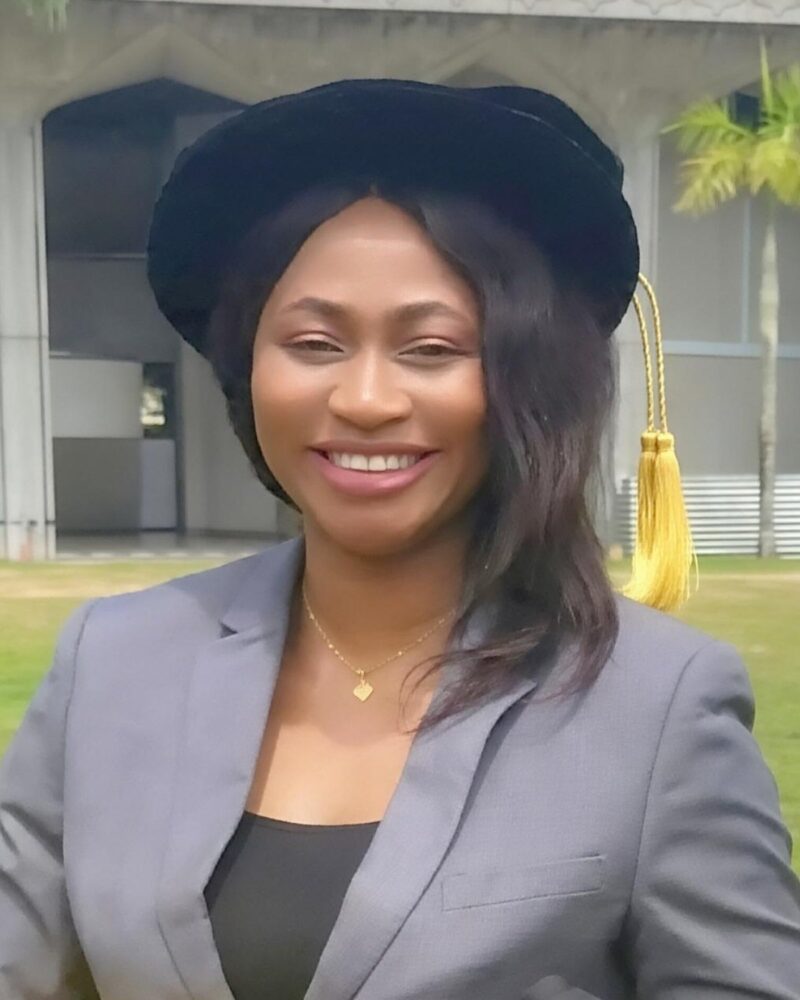
Dr. Tina
Lead Instructor
Dr. Tina is a Master Braider and the Lead Instructor of Celegant Braiding Academy. She has braided more than 3,500 clients since 2016, has run her own salon since 2015, and teaches every Academy program personally, with a co-instructor alongside her.
- Master Braider
- Braiding clients since 2016, and running her own salon since 2015
- Experienced braider and loctician
- Experienced wig maker, and wig and weave installer
- A working braider at Celegant Hair Edmonton, not only an owner
Dr. Tina teaches from experience rather than from theory, and adapts her pace and her explanations to how each student actually learns. Her approach in her own words is on the About page. Every cohort is taught by two instructors. Dr. Tina chooses the co-instructor for each program from the braiders working under her who specialise in that style, and we do not publish their names because the person teaching a given cohort can change.
Questions people ask before enrolling
Do I need any experience?
No. Module 1 assumes you have never braided. A large share of every cohort has never sectioned a head before.
Do I need a licence to enrol?
No. There is no licence requirement to take this course. What a certificate does and does not entitle you to in Alberta is explained in full on this page and in our FAQ.
Is there an online version?
No. Foundations is in person only. The only online program we sell is the Empire Blueprint salon business course, which is a different thing entirely.
What if I miss a session?
You need at least 80% attendance and at least 70% on your assessments, which are assignment based to complete the program, so the odd missed session is survivable and a pattern of them is not. Attendance is counted in hours, not sessions, so arriving 90 minutes late costs you half a session.
Tell us in advance if you can. We will tell you what you missed and what to practise, and where a session can reasonably be repeated with a later cohort we will try to arrange it. One-to-one catch-up teaching is $99 for a three-hour session, which is below our normal hourly rate because it is meant as goodwill rather than a revenue line.
If you finish below the attendance standard you receive a letter of attendance rather than a certificate. That is convertible: complete the missing hours with a later cohort within 12 months and the certificate is issued. Missing a session does not entitle you to a refund for it. See Attendance and code of conduct.
What do I need to bring?
A starter kit and station setup are covered in module 1, and the kit is included in your tuition at no extra cost: a mannequin head with human hair, a tripod stand, hair clips, a rat tail comb and braiding hair, all yours to keep.
If you already own some of it, bring what you have and we will supply the rest. Otherwise just bring yourself, comfortable clothes and a notebook.
Do I practise on real people?
You work on mannequin heads throughout. We do not use live models in training. Nobody is made to work on a person before they are ready.
How much practice is expected between sessions?
Enough that the style weeks stick. The hands-on weeks move quickly and home practice is what carries technique from one session to the next.
Can I pay in instalments?
Yes, and there is no deposit. You can pay the tuition in full, or split it into 4 interest-free instalments with Afterpay at the Square checkout, at no extra cost to you.
The instalment option is Afterpay, offered through our payment processor, Square. It costs you nothing extra. You choose it at the payment step inside the secure Square checkout, not on a separate page. Afterpay is an agreement between you and Afterpay rather than with Celegant Braiding Academy, so read their terms.
What is your refund policy?
In short: 10 days to change your mind from the day we confirm your place, with everything refunded. After that, the more notice you give, the more you get back, on a fixed schedule we apply the same way to everybody.
Cancelling before the program starts: 100% at 30 days or more, 90% between 15 and 29 days, 75% at 14 days or fewer. After teaching starts it is worked out pro rata on the contact hours we have delivered.
If we cancel or move a cohort, you choose: a full refund or the next cohort. No fee, no argument.
The full policy, including deferrals, transfers, Afterpay and employer-funded places, is on Refunds, withdrawals and rescheduling.
How old do I have to be?
18 to enrol and attend on your own. If you are 16 or 17 you are welcome, but a parent or guardian has to sign your enrolment confirmation, health declaration and waiver, and be reachable by phone while you are in class. Because a minor cannot enter a binding contract, the guardian is the person contracting with us.
We do not accept students under 16. Classes run into the evening and the room has sharp tools, hot water and eight people working at once.
The full wording is in our Terms of Enrolment.
Is the classroom accessible?
Here is exactly what the space is like, without the reassuring gloss.
- Step-free entry. Unit 316 is in building 3, not on a third floor. The site is single storey, so there are no stairs and no lift.
- Parking is ample and includes two designated accessible spaces.
- The salon and store are wheelchair accessible.
- The washroom is not a wheelchair-accessible washroom. A wheelchair fits, but there is not enough clearance to turn around and there are no grab bars.
If you have an access requirement, call or text 368-299-4358 before you register and we will tell you honestly whether we can meet it. More on Accessibility.
What happens after I download the curriculum?
You get the document by email straight away. We follow up to answer questions and to tell you when the next intake opens.
When you decide to enrol you can reserve your seat and pay online, or ask us for a call first. Nobody is going to phone you and push.
What students from our previous braiding masterclass say
I would highly suggest anyone looking to learn the skill of braiding to take the masterclass. It is very informative and most definitely worth the price! The instructor/owner is amazing and it is a great class!
Ten weeks. Sixty hours. One decision to make today, and it is a small one.
Read the curriculum. Everything is in it: the schedule, all seventeen modules, all seventy-six lessons, the tools, the capstone standard, the tuition and the funding routes. Then decide.